When a problem affects not just one person but the whole community, an entire settlement, a street or an elderate, a shared conversation can be the first step towards change. General meetings of residents are a civic participation tool that helps to discuss important issues, form a common position and convey it to the local authorities.
There is no public transport stop, a road needs repairing, street lighting is lacking, a public space has been neglected, or residents want to propose their own vision for the development of a settlement or neighbourhood. Such problems are often discussed among neighbours, on social media or at chance meetings. But how can individual opinions be turned into a shared position that local self-government bodies can consider?
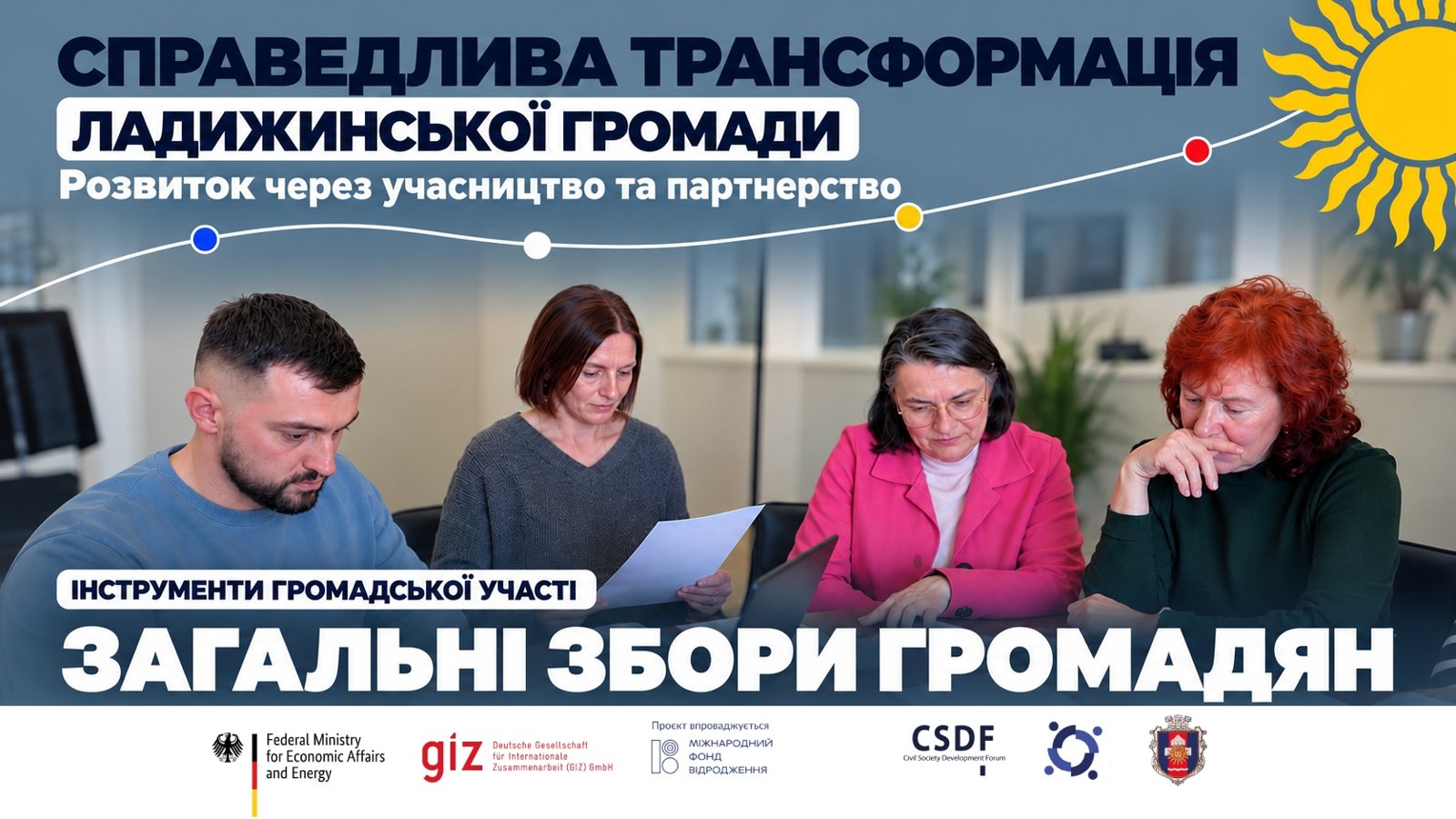
One way: general meetings of residents
This is not just a meeting to exchange views. When properly organised, general meetings make it possible to discuss issues of local importance, agree on proposals and adopt decisions that the local authorities must consider in the manner set out in the community’s Charter.
When one conversation is not enough
Imagine that residents of a community, or of one of the city’s neighbourhoods, want to discuss how to make their area more comfortable to live in. Some suggest building a playground, others – improving street lighting, repairing a road or creating a place for shared leisure. Each of these proposals matters, but how do you decide what needs to be done first?
You can appeal to the Ladyzhyn City Council individually, post proposals on social media or discuss them with your neighbours. However, when an issue affects many people, it is far more effective to come together, hear different opinions, identify shared priorities and draw up agreed proposals for the local authorities.
This is exactly what general meetings of residents are for – a form of civic participation that allows people to discuss issues of local importance together and take part in finding solutions.
Which issues can be brought to a general meeting?
The list of topics depends on the needs of a particular area. Residents can discuss issues of local importance that fall within the powers of local self-government bodies.
For example:
- Improvement and infrastructure. Road repairs, street lighting, setting up a playground, maintaining public spaces.
- Education and services. Accessibility of educational institutions, transport connections, the quality of housing and utility services and other services.
- Development of a settlement. Proposals for development programmes, preservation of municipal property, improvement of transport infrastructure.
- Community governance. Discussion of current issues in a specific area, such as an elderate.
- Residents’ self-organisation. Initiating the creation of a self-organisation body of residents (SOB) if people want to organise themselves to resolve shared issues on their street, in their block or in another part of a settlement.
It is worth remembering that general meetings do not replace all other participation tools. If you need to discuss a specific draft decision with the local authorities, public hearings or public consultations may be more suitable. If residents want to put a specific issue before the local council, it is also worth considering the local initiative mechanism.
General meetings or a residents’ conference: what is the difference?
General meetings involve the direct participation of residents of a defined area. These may be all residents of the community or, for example, residents of a particular city, street or elderate – depending on the format and rules established in the community.
If a community is large or covers many settlements, it can be difficult to gather everyone who wishes to take part in one place. In such cases, a residents’ conference may be used – a format in which delegates elected by residents in accordance with an established procedure take part.
For example, it makes sense to discuss the improvement of a particular street with the people it directly affects. And where an issue is important for several settlements in the community, it is worth deciding how to ensure that their residents are represented.
The specific procedure for holding a meeting or conference can – and should – be checked in the Charter of the Ladyzhyn City Territorial Community and the relevant local regulation. The new version of the Charter of the Ladyzhyn community, which describes general meetings in detail, is currently open for public discussion (the link is at the end of the article); until it is adopted, the current rules apply.
A successful practical example: how residents of Voznesensk almost doubled the size of the local cemetery
In 2012, residents of the Priame neighbourhood in Voznesensk, Mykolaiv region, faced an acute problem: the local cemetery was overcrowded. New burials had to be made between the rows and graves, and next to the fence. The situation required an urgent solution.
The city council allocated funds for work to allot a plot of land for expanding the cemetery. However, despite the process having begun, the cemetery’s boundaries remained unchanged for a long time.
Residents decided not to wait for someone else to solve the problem for them. The self-organisation body of residents (SOB) “Perlyna Haiu”, which represented the interests of the neighbourhood, initiated joint work on resolving the problem. General meetings of residents played an important role in this process, making it possible to discuss the situation, identify the community’s needs and agree on next steps.
The work that followed required persistence: SOB representatives held negotiations, corresponded with the responsible bodies, looked for ways to attract resources, organised fundraising campaigns and mobilised material and human resources.
As a result of these joint efforts, the area of the local cemetery was almost doubled.
Activists of the same SOB combined the meetings with other tools: through a local initiative, they secured a decision of the city council, which allocated funds for a borehole to supply water to the neighbourhood. In this way, the residents’ shared position became a council decision.
This example shows that general meetings of residents are not only an opportunity to voice a problem but also a way to unite people around a common goal. They help to identify what concerns residents, discuss possible solutions, involve representatives of the local authorities and agree on joint action.
At the same time, meetings alone are not enough: it is important that the discussion is followed by concrete steps, and that residents, civic initiatives and the local authorities are ready to cooperate.
The story of SOB “Perlyna Haiu” is a reminder that even difficult problems can be solved if residents organise themselves, pool their resources and work consistently towards a common goal.
How to organise a general meeting in the Ladyzhyn City Territorial Community?
The initiative to hold general meetings can come either from the Ladyzhyn City Council or from the residents themselves. So, if residents of the Ladyzhyn community, of a certain part of it or of the city of Ladyzhyn have shared proposals or want to discuss an issue important for their area, they can form an initiative group and propose holding a general meeting.
To do so, it is enough to use the procedure provided for by the community’s Charter and the relevant Regulation on General Meetings (Conference) of Residents. This mechanism helps to turn such an initiative into an organised discussion and to form shared proposals for local self-government.
Step 1. Define the problem and the desired outcome
Start with an issue that unites residents and matters for the development of your area. For example, it might be improving road infrastructure: identifying sections that need repair as a priority, building pedestrian paths or making traffic safer. It helps if the initiative group collects residents’ proposals in advance, familiarises itself with possible ways of resolving the issue and decides which of them are worth bringing to a shared discussion. This will make the general meeting substantive and its results concrete and useful for the Ladyzhyn community.
Step 2. Check the rules in your community
Find the Charter of the Ladyzhyn City Territorial Community and the Regulation on General Meetings (Conference) of Residents. They set out the rules for initiating, convening, preparing and holding the event, the requirements for participants, the procedure for adopting decisions and for the subsequent consideration of those decisions.
Also check who can initiate a meeting, how many signatures or other confirmations of support must be collected, which documents must be submitted and which deadlines must be met.
Step 3. Form an initiative group
Agree on who will coordinate the preparation and be responsible for communicating with residents, preparing documents, arranging the venue and chairing the meeting.
Having responsibilities assigned in advance will help avoid a situation where, on the day of the event, nobody knows who should lead the meeting or record the proposals.
Step 4. Submit the documents and agree organisational matters with the city council
If the Regulation provides for submitting a notification, an appeal or other documents to the Ladyzhyn City Council, do so in the established manner and within the proper deadlines. Clarify organisational matters: the date and place of the meeting, the accessibility of the premises, the possibility of city council representatives taking part and of involving subject-matter specialists. This will make the cooperation constructive.
Step 5. Inform residents
In the announcement, state the date, time, place, agenda, the initiator and contact details for further information. Use the available communication channels: notices in the settlement, local social media groups, community information resources and personal invitations.
Step 6. Hold the meeting and record the results
Give residents an opportunity to speak and to hear the position of city council officials and, if necessary, of specialised institutions. Based on the results, draw up minutes and a decision in accordance with the established procedure. Formulate the proposals and the expected actions clearly and, if necessary, designate persons authorised to represent the participants’ position.
Step 7. Follow how the decisions are considered
After the general meeting, submit the documents to the city council following the proper procedure, find out how and within what time frame they will be considered, and inform residents of the results. If an issue requires budget funding, additional approvals or the development of a programme, take this into account when planning further steps.
Preparation takes time: if the initiators are the residents themselves, it is advisable to allow several weeks for organising the meeting and preparing the documents. The exact deadlines are set out in the Regulation and depend on the complexity of the issue.
General meetings are teamwork between residents and the city council
Successful general meetings are the result of joint work by the initiators, residents and the community’s local self-government bodies. The initiative group takes on organising the process, communicating with residents, drawing up the agenda and preparing proposals. The community authorities, for their part, can help with the necessary information, explain procedures, involve responsible specialists and provide clarifications on possible ways of resolving the issues raised.
It is important that general meetings become a space for constructive dialogue and a joint search for solutions that benefit the community. Residents know the needs of their area best and can suggest ideas for its development, while representatives of the local authorities can help assess how feasible those ideas are, and explain the powers of local self-government bodies, the available resources and possible next steps.
It is precisely the combination of residents’ initiative and the professional experience of local authority representatives that creates the conditions for a substantive discussion, for taking different opinions into account and for working out well-considered decisions. Openness to proposals, mutual respect and readiness to cooperate help to find common approaches even on issues where views differ.
After all, the main value of general meetings lies not only in giving everyone a chance to be heard, but also in turning shared ideas and proposals into concrete steps to improve life in the community.
What happens after the meeting?
The end of a general meeting is the beginning of the next important stage: putting joint work into concrete action. To this end, the proposals and decisions formed during the discussion are properly drawn up and submitted for consideration to the relevant local self-government bodies.
General meetings give residents an opportunity not only to voice their ideas but also to form an agreed position and officially present it to the Ladyzhyn City Council. Further consideration of such proposals makes it possible to determine how feasible they are, what resources are needed and in what order to proceed.
To keep this process consistent, meeting participants can agree in advance on who will be responsible for handing over the documents, maintaining contact with city council representatives and informing residents of the outcome of the consideration. If implementing the proposals requires budget funding, additional approvals or inclusion in local programmes, these issues may become the subject of further joint work.
What can prevent a meeting from taking place?
General meetings require not only interest but also proper organisation.
Possible difficulties include incorrectly drawn-up documents, violations of the established procedure, insufficient informing of residents, the lack of the required number of participants or the organisers’ inability to ensure a constructive discussion.
It is also worth remembering that a meeting’s decision is the residents’ position, not an order to the council. For it to become a council decision, it often has to be taken further through a local initiative, deputies or a local programme.
Under martial law, security and the ability to take part for people who cannot attend in person require additional attention. If local rules allow, it is worth considering a hybrid format using videoconferencing and determining the procedure for remote participation in advance.
It is equally important to choose the right tool. If a problem can be solved by an individual appeal, gathering people may not be worthwhile. But if an issue requires broad discussion, the reconciling of positions and shared proposals, a general meeting can be an important step.
Where to find information and where to start?
If there is a problem in your town, village, street or elderate that is important to discuss together with other residents, start with three simple actions:
- Talk to your neighbours. Find out whether other residents share your concern and what changes they expect.
- Find the community’s Charter. Check whether general meetings (a conference) of residents are provided for, how to initiate them and what requirements must be met.
- Decide on the next step. If the problem needs a shared discussion, join forces with other interested residents and read the regulation on how to organise a meeting properly. If this information is not available on the website, it is worth submitting an information request so that the authorities explain the rules in force. You can also turn to the current legislation to understand the basic principles.
Civic participation does not begin with a big campaign or necessarily with a ready-made solution. It often begins with a simple question: “Does this bother others too, and what can we do together?”
General meetings of residents are one way of turning such a conversation into a shared position and concrete proposals for the development of the community. After all, local issues should not remain mere topics of conversation on the street or on social media. Residents can unite, take part in resolving shared matters and use tools that give them the opportunity to be heard.
The draft of the new version of the Charter of the Ladyzhyn community, which sets out the procedure for holding general meetings, is already open for public discussion. Read it and submit your proposals: https://ladrada.gov.ua/publichna-informatsiia/novyny-ladyzhynskoi-miskoi-rady/provedennia-hromadskoho-obhovorennia-ta-hromadskykh-slukhan-proiektu-statutu-ladyzhynskoi-miskoi-terytorialnoi-hromady-haisynskoho-raionu-vinnytskoi-oblasti.html
We are also pleased to announce that enrolment for the Academy of Participatory Just Transition will open soon! If you intend to learn more about how to hold general meetings, want to develop your community, involve residents (men and women) in decision-making and implement changes that take into account the needs of different groups of the population – follow our announcements. We will be glad to see you at the Academy, where you will gain new knowledge and practical tools and become part of a community that creates just change.