The lighting near a building does not work, the community is planning to reconstruct a square, and residents want to propose their own project or influence how budget funds are allocated – what should they do, and how can they be heard by the local authorities? In this article, we use simple everyday examples to explain how the Community Charter turns the right to participate into concrete tools of influence and helps residents get involved in resolving local matters.
When people hear the phrase “the Charter of a territorial community”, their first association is unlikely to be road repairs, public transport, shelters, the budget or the development of a neighbouring square in the city centre. It is more likely to bring to mind a large legal document, a kind of encyclopaedia that only the city council needs.
But a good Community Charter has an entirely different practical meaning. It is a kind of set of local rules of the game between the residents and the community authorities.
It helps answer very down-to-earth questions: what to do if a problem affects more than just me? How do I bring my proposal before the city council? How can I find out what our authorities are planning? How can I influence a decision before it has already been adopted? How can the residents of a village or an elderate form a shared position? And what should be done when it comes to our community’s budget?
It is in such situations that the Charter stops being “a document on a website” and starts working for people.
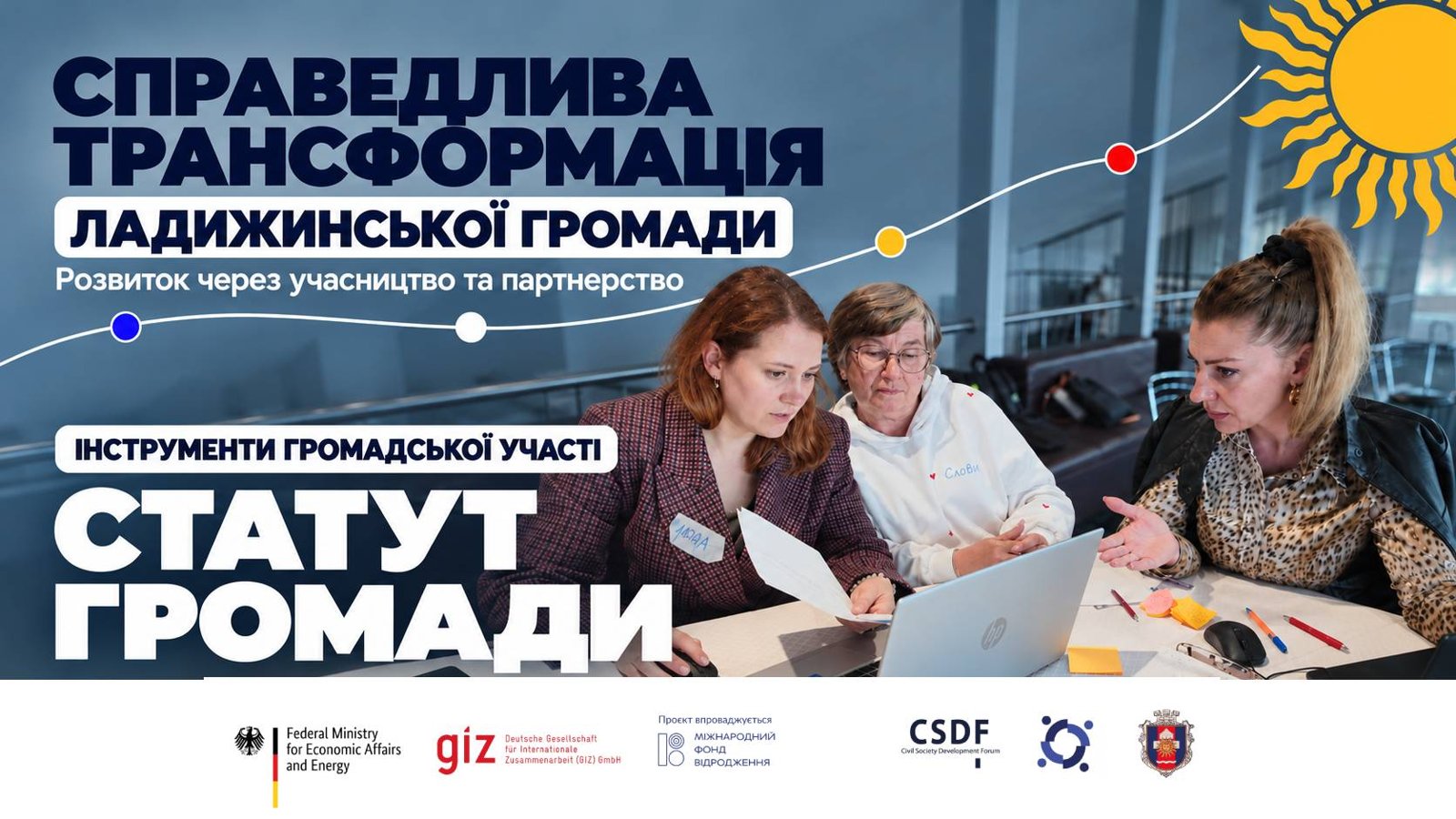
When a problem can be solved with a single appeal
Let us imagine a simple situation: the street lighting near a building has not worked for several weeks. Or a bus stop has broken down. Or attention needs to be drawn to the poor condition of municipal property.
It is unlikely that this calls for public hearings attended by a hundred people.
In such a situation, a resident first of all needs a simple channel for interacting with the authorities: an appeal, an electronic reception service, or a suitable e-service.
But now let us change the scale of the problem. For example, in several multi-storey buildings the lifts have not worked for years or need major repairs. People want the community to have a programme for modernising them and sharing the costs. This is no longer just a report of a fault. The residents are, in effect, proposing a new solution for the whole community.
And this calls for entirely different tools.
That is exactly why the Charter matters: it offers not a single channel for “writing to the authorities”, but a set of different ways of taking part for different situations.
When one opinion is not enough
Sometimes a person has a good idea but understands that it will sound much stronger if hundreds of other residents support it.
For example: “Let’s build a safe pedestrian crossing near the school”, “Let’s create a youth space in the community”, “Let’s launch a municipal bus to remote settlements”.
Collective mechanisms exist for such situations, including e-petitions. Their logic is quite clear: there is a proposal, then residents demonstrate their support for it, and once the established conditions are met, it moves on to official consideration. In other words, a petition helps to show that this is not only my problem or idea – it matters to other people as well.
And the Charter, together with the relevant local regulations, makes the rules of such a mechanism clear to everyone.
When residents want to put an issue to the city council themselves
Here is another situation: people do not simply want to report a problem or gather support. They already know which solution they are proposing.
For example, parents and civil society organisations propose creating an accessibility programme in the community. Or residents want to introduce a programme to support condominium associations. Or young people propose approving a separate programme for developing youth spaces.
A local initiative comes in handy here. Its fundamental difference is that residents themselves initiate the putting of an issue before the local self-government body.
If an appeal sounds, roughly, like “please pay attention to this problem”, a local initiative is much closer to “here is an issue and the solution we propose to be considered”.
This is a much higher level of participation, and it, too, is set out in the Community Charter.
When you need not to write to the authorities, but to talk to them
Let us imagine that in one of the community’s settlements there is an old building that could be converted into a shelter. But opinions differ.
Some residents believe this should be done immediately. Others suggest reconstructing an existing shelter. City council officials explain the budgetary and technical constraints. People are interested in deadlines, capacity and accessibility for people with disabilities.
An electronic appeal is no longer enough here. Dialogue is needed.
This is exactly what public hearings are for. Their value lies precisely in the fact that residents can discuss an issue directly with council members and officials, ask questions, listen to the arguments of the other parties and put forward their proposals.
This is a very important distinction, because:
- an appeal is to inform;
- a petition is to demonstrate support;
- a local initiative is to propose an issue for consideration;
- public hearings are to discuss it publicly.
And the Charter helps bring these mechanisms together into a single system, so that a person can choose the one that fits their situation.
When the authorities have not yet decided anything – and that is the best moment to take part
There is one more scenario. For example, the city council is planning a reconstruction of the central square. Only after the project has been approved do residents learn that part of the greenery is to be removed. Posts appear on social media, outrage grows, appeals are filed, and demands are made to reconsider the decision.
But it is far more effective to ask people’s opinion before a decision is made. This is exactly what public consultations are for.
For example, the community is offered three options for reconstructing the square. Residents, entrepreneurs, people with disabilities, parents of small children, cyclists and young people may have entirely different needs. A consultation makes it possible to gather these positions, analyse them and use them when preparing the decision.
In this case, public participation works not on the principle of “the authorities decided – people reacted”, but on the principle of: “there is an issue – people were asked – the proposals were analysed – a decision was made – the result was explained”.
This is an entirely different quality of interaction, and it, too, is set out in the Charter as a form of the community’s participation in resolving matters of local significance.
When the issue concerns your town, village or street
Not every problem requires the participation of the whole community. A town may face a question about bus services. In a particular village, the pressing issue is the improvement of the area. On one street, it is lighting or traffic.
For such cases, the Charter provides for general meetings or a residents’ conference. Their point is simple: the people who are directly affected by the issue come together, discuss it and form a shared position.
For example, residents have three proposals: build a playground, set up parking spaces, or first of all repair the lighting. A general meeting makes it possible not to guess “what people want”, but to give the people themselves the chance to decide.
This mechanism is especially important for a large urban community such as Ladyzhyn, which includes many settlements. The voice of a small village should not get lost simply because the administrative centre is dozens of kilometres away.
When the issue comes down to money
Sooner or later almost every local problem runs into the budget. Because repairing a lift takes money, equipping a shelter takes money, building a sports ground takes money again.
And here a more difficult question arises: who decides what is more important?
That is why a modern Charter provides for residents’ participation not only in discussing problems, but also in planning and allocating local budget funds.
The formats and tools may differ: budget consultations, public hearings, submission of proposals, a participatory budget and other mechanisms.
For example, the community has a limited sum for improvement works. Residents propose ten different projects. One district asks for a public garden, another for a sports ground, a third for a barrier-free route.
Residents’ participation in the budget process does not mean that every wish is automatically funded. But it makes the public demand clear and allows it to be taken into account when priorities are set.
When people want to work with the authorities on a permanent basis
Not all issues can be resolved with a single petition or a single set of public hearings. Veterans’ policy, accessibility, the needs of internally displaced persons, youth policy and entrepreneurship are areas where ongoing interaction is needed.
This is what advisory bodies exist for: youth councils, IDP councils, veterans’ councils, accessibility councils, participatory strategic committees and others.
And here the model is entirely different, one governed by the principle that “community residents, representatives of business and the authorities work together on a given area on a regular basis”.
And the Charter helps to establish such participation as a substantial part of local governance, rather than an exception that depends solely on the goodwill of a particular official.
What about children and young people?
A community is not only its adult voters. Children and young people also use public transport, schools, sports facilities, parks and youth spaces. Sometimes they are the ones who see best the problems that adults simply do not notice.
That is why a separate strand of the modern Charter is the participation of children and young people in local self-government.
For example, pupils see that their schoolyard lacks a place to rest. They can do more than simply ask the head teacher to do something: within a school participatory budget, they can develop their own project, present it, gather the support of other schoolchildren, choose the winning projects by vote, and then enjoy the results together with everyone else.
When you do not feel like going to the city council
Some ten years ago, public participation was often associated with a paper application, an official’s office and being present in person at a meeting.
But times move on. Today, part of the interaction can take place online. E-petitions, digital consultations, electronic appeals, video conferences, online surveys and electronic participation platforms make it possible to take part for people who work, look after children, have difficulty getting around or live far from the administrative centre.
That is why digitalisation and e-governance are becoming an important part of the modern Charter.
A digital tool here must not be just an attractive service that appears on the community’s website one day and disappears the next. The Charter creates a regulatory basis for its use, while separate regulations define the specific procedure.
In very simple terms: “The Charter says that the possibility exists. The regulation explains how it works. The digital tool makes it possible to use it”.
When a resident wants to know what the authorities are actually doing
Participation is impossible without information.
It is hard to influence the budget if people do not know what the funds are planned to be spent on. It is impossible to discuss a draft decision properly if it has not been made public. It is difficult to attend a meeting if information about it cannot be found anywhere.
That is why an important part of the Charter is about the openness and transparency of local authorities.
For a resident, this is a very practical matter: where to find city council decisions, draft documents, information about meetings, officials’ reports, budget documents and the results of public discussions.
And here transparency is directly linked to participation. Because first a person must know what is happening. Then have the opportunity to speak out. And, finally, see what happened to their proposal.
When the Charter helps the community determine its future
For the Ladyzhyn community, just transition takes on particular importance. Changes in the energy sector and the economy affect not only enterprises, but also jobs, community income, the development of new types of business and the future of the town as a whole.
That is why it is important that just transition is reflected directly in the Charter. Its provisions link the community’s sustainable development with the principles of just transition, and the Just Transition Plan with the community’s system of strategic documents. At the same time, the mechanisms of public participation provided for by the Charter give residents the opportunity to take part in discussing and shaping the decisions that determine the further development of Ladyzhyn.
And this is not merely a norm “on paper”. During the development of the Just Transition Plan of the Ladyzhyn community, the public was already involved in identifying problems, priorities and future solutions through discussions, focus groups, and the submission of proposals and project ideas.
Thus, the Charter in effect secures for the future an approach that is already applied in practice: decisions on the community’s transformation should be shaped not only for residents, but with their participation. This makes it possible to involve the public not only in developing the Plan, but also later – in its implementation, in discussing the results and in updating development priorities.
The Charter is needed not when everything is fine
The value of the Charter is best seen precisely when difficult questions arise:
- Who is to be given the floor?
- Who can initiate hearings?
- How do I submit a local initiative?
- Can residents influence the budget?
- Where must the results of public consultations be published?
- Is it possible to take part remotely?
- What is to be done with people’s proposals after public hearings?
- How can the residents of a particular village bring their position to the city council?
Without established rules, the answer may depend on the situation or on someone’s conscience.
So the Charter is needed for a different approach: the rules of interaction should be known in advance and the same for everyone.
When does the Charter not work?
The Charter will not work if it remains merely a document on a website and residents do not know about their opportunities or do not understand how to use them. That is why it is important that the mechanisms provided for by the Charter become part of the everyday interaction between residents and the city council and are actively used in practice.
Not “the authorities and the community”, but the authorities together with the community
Perhaps this is the main meaning of a modern Charter. A community is, first of all, its residents.
So the Charter is not needed in order to create yet another large document with dozens of articles. It is needed in order to agree on clear rules for living together and interacting.
A problem of a single building can begin with an appeal. A shared problem of a district can lead to public hearings. An idea of active residents can become a local initiative. A draft city council decision can go through a public consultation. A village’s needs can be discussed at a general meeting. An idea of schoolchildren can be implemented through a school participatory budget. And issues that matter to the community can be taken into account in strategic and budget planning.
That is why a good Charter is not a document about how the authorities work. It is a document about how a community manages its own affairs and how every resident can become part of that process.
An example from practising communities
In the Magdalynivka community in the Dnipropetrovsk region, officials, council members, the public, local farmers and active residents were involved in drafting the Charter. After its adoption, the focus shifted to practical application: in particular, the Youth Council mastered the mechanisms of public participation and drew up an Action Plan for 2026–2027.
In the Rozdilna community, the public hearings on the Charter became a platform for dialogue with the authorities. The problems of the elderates raised by residents were subsequently addressed through citizens’ appeals, which contributed to improvements in water supply, lighting and the improvement of the area.
The Ladyzhyn community also has its own story of developing a modern Charter. During its drafting, a Working Group was formed with a participatory composition: officials and council members of the city council, representatives of civil society and the expert community, including from the Association of Coal Communities of Ukraine, narrow-profile specialists and active residents of the community. About 70% of the proposals and amendments to the text of the Charter come from the public. The final version of the “Little Constitution” will soon be prepared and published on the official website of the Ladyzhyn City Council. That is how the public discussion will begin, and every resident will have a chance to submit their proposals on this extremely important document. So, dear residents of Ladyzhyn, make use of the opportunity to leave your mark on the community’s history – visit the official website and submit your proposals and comments on the draft Charter very soon!
We are also glad to share some news: in the coming days we will open enrolment for the Academy of Participatory Just Transition. We will publish the full announcement soon!