“Where do I go? Which documents are needed? Does the community have such a programme? How do I propose my own idea?” In search of answers to these ordinary questions for the local authorities, we often run into new ones: where to look for information, whom to call, and how to make sense of decisions and requirements written in bureaucratic language.
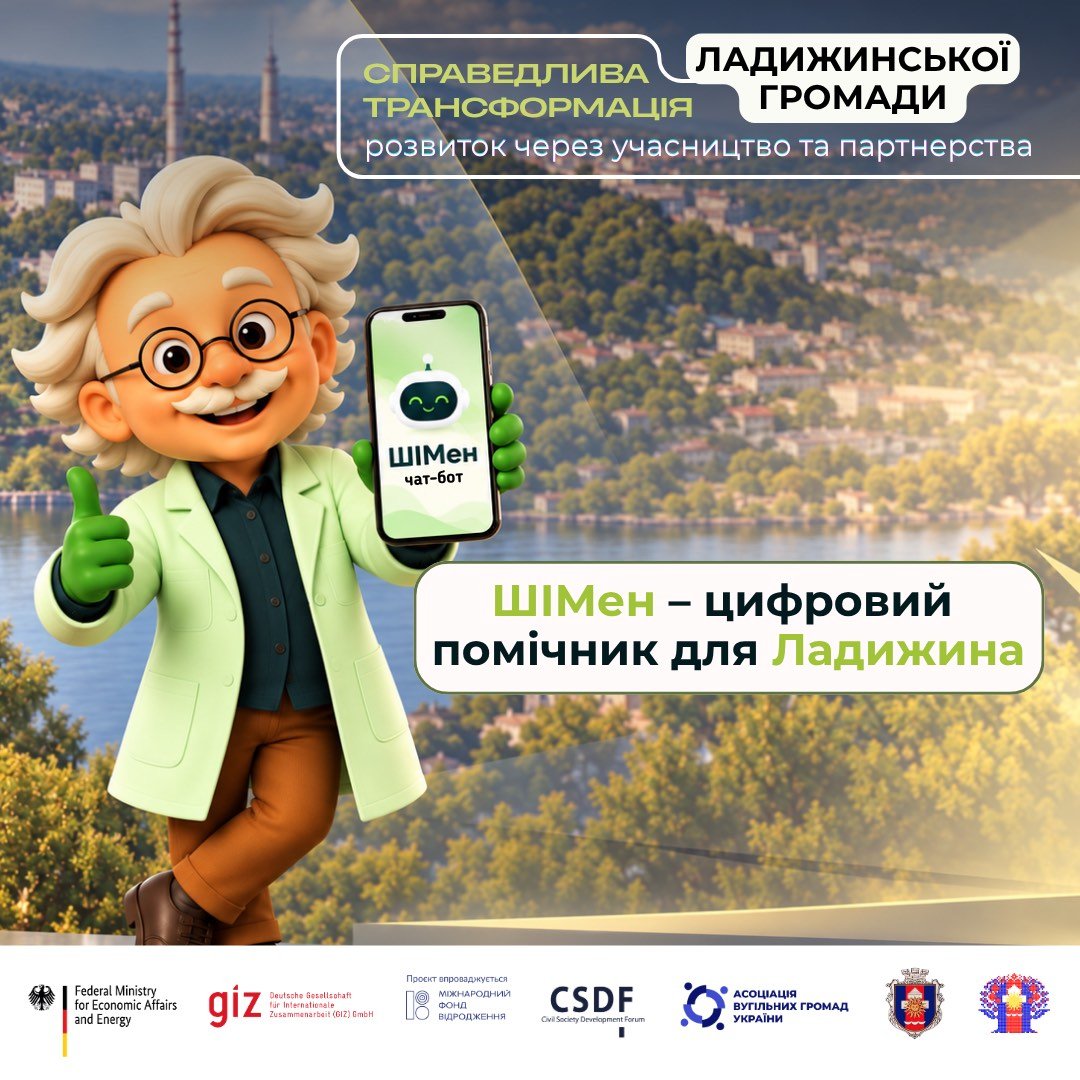
In the Ladyzhyn community, there are plans to make this journey simpler with the help of AIMen, a digital assistant that people will be able to talk to in plain language. It is meant not merely to find the information you need, but to explain what to do next: where to go, how to use local programmes, how to submit a proposal or an appeal, how to take part in decision-making and how to make sense of the changes awaiting the community.
You will be able to talk to AIMen as you would to an acquaintance who knows local affairs well. There is no need to know the name of a programme or a document, to look for the responsible department or to find official wording. Instead, you can simply write that you want to learn a different profession and are looking for training opportunities in the community. The assistant is then meant to work out what you are asking and to find the relevant information in its knowledge base.
In reply, a person will receive an explanation that gets to the point, rather than just a link to a lengthy document. AIMen will suggest the sequence of steps: which documents to prepare, whom to approach, at what address and during which reception hours.
In the same way, it will be possible to find out about local support programmes for veterans (men and women), internally displaced persons or people who have returned from abroad. Entrepreneurs will be able to ask about renting municipal property, permitting procedures and support for business. Where the information is available, the assistant will also suggest the contacts of civil society organisations that it makes sense to approach.
Importantly, the answer will take into account the circumstances the person has described. After all, the same “I need help” can conceal entirely different needs.
The assistant will work in Ukrainian on the community’s official website and in a messenger app. It will be possible to reach it around the clock, including after working hours, when offices are already closed.
Taking part in community decisions
Understanding the authorities’ decisions is only part of the matter. Sometimes you want to propose your own idea, draw attention to a problem or influence a decision that is still being prepared. For that, you need to know how and when to submit your proposal so that it can be considered.
For example, the council is preparing a programme that affects your work or your family’s needs. You can see what it lacks. How do you submit a proposal? Can you join the discussion? Which deadlines are important not to miss?
AIMen is meant to explain the available ways of taking part and to help choose the suitable one. This may be an appeal, an e-petition, a local initiative, or a proposal to a draft programme or to the community budget. A person will be able to find out the specific requirements: whether signatures are needed, how many, where to submit the document and who will consider it.
The assistant will also explain how to take part in public hearings, consultations, meetings at the place of residence, or discussions of draft decisions of the council and the executive committee. And for those who want to work on community issues on an ongoing basis, it will explain the opportunities for participation in public, youth or veterans’ councils.
Through it, it will also be possible to understand how bodies of self-organisation of the population work and how to attend meetings of deputies’ committees and council sessions. A separate part of the explanations will concern the accountability of the authorities: access to public information, reports of the city mayor and deputies, public scrutiny, and the procedures provided for evaluating the work of officials.
Behind these names stands a practical possibility: to know how to propose your own idea, ask a question and check that what was promised has been done. AIMen is meant to explain these possibilities in accordance with the rules currently in force in its own community.
From an idea to an appeal
Even when you know whom to approach, it is not always clear how to draw up the document itself. What should be explained, what data should be added, how should a request or proposal be worded? Here, too, help may be needed: how to set out your view clearly and what information must be stated so that the appeal can be considered.
AIMen will be able to prepare a draft of a petition, a local initiative, a public information request, or a personal or collective appeal. It will clarify the circumstances, suggest what information must be stated and propose a text that the person can reread and correct. This will apply to appeals to local authorities, municipal institutions and enterprises, advisory bodies, and civil society and charitable organisations.
AIMen will help prepare the text and explain where to submit it. The submission itself will remain the person’s responsibility. For example, for an e-petition, the assistant will draft the text and direct the person to the official platform. Signing it will take place there, with identity verification, and not in conversation with the assistant.
For the participatory budget and the School Participatory Budget, including the inclusive one, the help will consist in explaining the procedure: who can take part, when to submit a project, what the formatting requirements are and how voting works.
AIMen will provide information on the basis of the community’s documents. If a question requires legal advice or personal consideration by a specialist, that conversation will need to take place separately.
More time for complex cases
The better prepared a person is for an appeal, the easier it is for the staff of an institution to move on to the substance of the matter. It is precisely here that both sides will feel the benefit of a digital assistant.
Today, officials spend a great deal of time on repeated initial questions. Explaining the list of documents, naming the right department, confirming reception hours – each such conversation is necessary, but there may be many of them in a day.
It is expected that AIMen will provide a considerable share of these explanations. As a result, specialists will be able to devote more attention to complex appeals, in which it is necessary to study the circumstances, check documents or coordinate the work of several institutions.
Reception is also meant to become more convenient. If a person has found out in advance where to go and what to bring, there is less chance of having to come back because of a missing document.
But the help to the authorities will not be limited to saving time. Anonymised statistics of requests will show which topics concern people most and where they lack information. Frequent questions about a particular service may suggest that its conditions should be explained better. Unanswered requests will show what needs to be checked or added in the knowledge base.
For the local authorities, this is an opportunity to see which difficulties recur for many people. For example, numerous requests about retraining will become a reason to study this need more closely. And tracking unanswered questions will help check whether the necessary information becomes more accessible after the materials are updated.
In this way, everyday appeals will help the community notice problems that might otherwise be lost among individual phone calls and reception visits.
What trust will rest on
An important principle is built into AIMen’s work: answers must be based solely on the community’s official documents. It will not look for explanations on the open internet or transfer the experience of other cities to local issues. Its knowledge base will be built from the Charter, decisions of the council and the executive committee, regulations, local programmes, descriptions of services and contacts of departments.
Under every answer there will be a link to the original source and the date of its last update. It will be possible to go straight from the conversation to the document and check what the explanation is based on. If the necessary information is not available, the assistant is meant to say so honestly and suggest whom to approach, instead of inventing an answer.
The knowledge base will belong to the community. Responsible staff will be trained to update it and given the necessary tools, so that the service’s continued operation does not depend on the developer.
Privacy is also important. In its initial version, AIMen will work without registration or personal profiles. The history of conversations will not be linked to a particular person.
Statistics will show what people ask about, when and in which community, without any link to who exactly made the enquiry. The system will automatically hide typical personal data that a person may leave in a message. Functions that require confirmation of contact details will be switched off at launch. They can be added only upon a separate written request from the community.
Why a digital assistant matters now
The Ladyzhyn community is going through a just transition, so it is important that residents (men and women) understand how the planned changes will affect their lives. What opportunities for employment and retraining are envisaged? How are the needs of different groups of the population taken into account? What else can be proposed while the discussion is under way? The fairness of this process also depends on whether people can influence decisions about their own future. And for that, they need accessible explanations and a clear way to convey their views.
AIMen is meant to help people understand the Just Transition Plan. A person will be able to ask about their occupation, neighbourhood or family’s needs and receive an explanation with a reference to the relevant section – if such information is in the document.
It will also be useful between public meetings. After all, an opinion does not always form at the moment when people are given the floor. Sometimes you need to discuss what you have heard at home, consult colleagues, think over your own proposal. The assistant will suggest how to formulate it and submit it for consideration.
And people’s questions will give additional insight into what concerns them in connection with the changes. This information will be able to complement meetings and surveys during the development of the Plan.
When will AIMen become available?
In the Ladyzhyn community, the launch of AIMen is planned after the Charter of the territorial community is approved. This is important, because the assistant is meant to explain local participation rules that have already been adopted.
Development begins when the draft Charter is put forward for public hearings. The full preparation cycle for such a service takes roughly three to four months. Most time is needed for collecting and checking the official documents, so no specific launch date is being given for Ladyzhyn yet.
Before the service is opened, the community and the developer will check the answers to an agreed set of typical questions. This is a necessary quality check before making the service available to the community. The assistant is planned to be introduced within the project “Just Transition of the Ladyzhyn Community: Development through Participation and Partnership”. It is being implemented by the Civil Society Development Forum NGO jointly with the Association of Coal Communities of Ukraine, the Ladyzhyn City Council and the municipal institution “Local Economic Development Agency of Ladyzhyn”. The project is supported by the International Renaissance Foundation, Deutsche Gesellschaft für Internationale Zusammenarbeit (GIZ) GmbH and the German Federal Ministry for Economic Affairs and Energy.
No digital assistant will on its own make good decisions for a community. That remains the shared work of people and local authorities. But it can help them get to a meaningful conversation sooner – when a person knows their options, understands the next step and is able to take part. Then the distance between “I have the right” and “I can make use of it” becomes shorter.