What needs to change at school so that children feel more comfortable learning, communicating and spending time together? Adults usually have their own answers. But schoolchildren have ideas of their own too. What matters is giving them the opportunity to propose, discuss and implement these ideas.
This is exactly how the School Participatory Budget (SPB) works. It helps children gain their first experience of taking part in shared decisions and see the results of their own efforts. For the Ladyzhyn City Territorial Community, which is on the path of a just transition, such experience is especially valuable: the changes ahead require people who know how to cooperate and are ready to contribute to the development of their community.
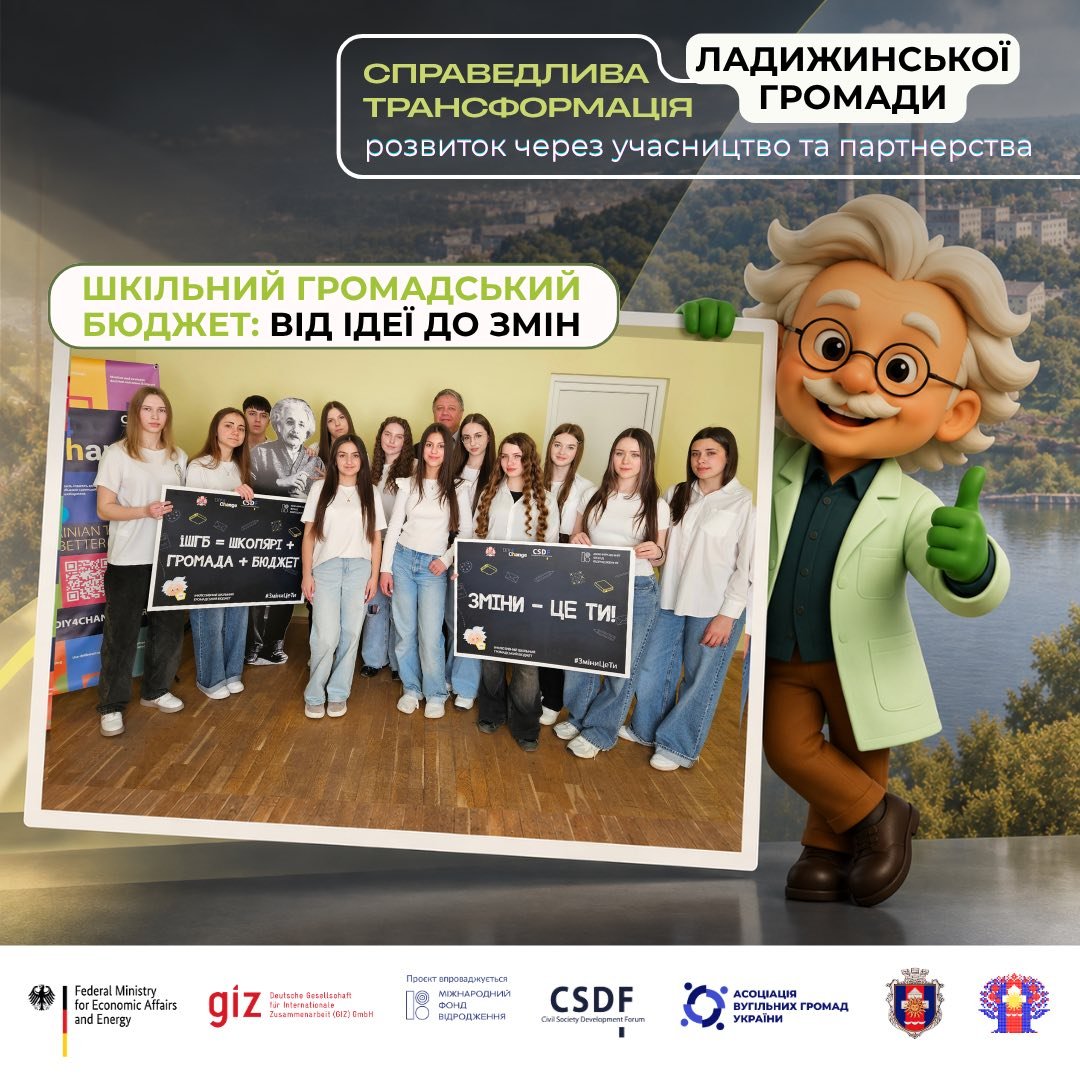
How an idea becomes reality
The School Participatory Budget is, above all, practical learning of civic participation. Students learn to influence decisions that concern their studies and the life of the school community: to identify common needs, propose solutions and agree on how to implement them.
First, participants go through training. They find out how to identify a common need, prepare a project and explain who will benefit from their idea and how. Then they form teams, discuss proposals with their peers, present their ideas and vote. While implementing the supported projects, children learn to share responsibilities and take responsibility for a common result.
This is what makes the SPB special: children immediately put their knowledge of civic participation into practice. They move from “it would be good to change something” to a concrete action plan. Adults help them understand the rules and the implementation, while students’ needs and decisions remain at the centre of the process. The main result is that participants already know how to influence the educational process and develop their community, and have their own experience of such interaction.
The Ukrainian SPB model has been implemented since 2019. It was developed by the Civil Society Development Forum NGO at the request of a Council of Europe project in Ukraine. The training combines game-based tasks with work on real projects, and a dedicated online platform helps organise participation and voting. Last year, with the support of the Open Government Partnership (OGP) and the European Union, the model was adapted to involve a wider range of children, including children with disabilities and special educational needs, from different settlements and forms of education.
Experience that stays
The School Participatory Budget teaches children to look at their own idea through the eyes of others: whom will it help, do their peers share this need, what is needed to make it happen? In looking for answers, children learn to listen, negotiate, plan expenses and share the work. This is how they gradually come to understand how a personal wish can become something useful for many.
When students themselves identify what they lack at school, adults can see a familiar space in a new way. For example, a room for teachers’ meetings can become a place where children talk, play board games and exchange books. This is exactly what happened at the Sosnivka Gymnasium of the Novovodolazka community: thanks to the SPB, a “Quiet Hub: a gadget-free zone” was created there, and the teachers gave up their staff room for it. This idea gave children the experience of a shared decision and created more opportunities for communication and interaction at school.
A project of one’s own can also help a student discover their abilities and share knowledge with others. In the Zviahel community, a student named Maksym joined the SPB with the idea of popularising robotics. While preparing and defending the project, he became so absorbed in the subject that he began teaching robotics to his peers at school. Later he was offered a teaching position at a private school. In this way, his passion became part of other children’s learning and his first step towards professional experience.
In the same community, 14 SPB participants received trainer certificates and trained more than a thousand students. They helped others prepare projects and present their ideas. Programme participants also join youth councils and implement initiatives for young people in the community. The experience gained at school helps them act beyond it as well.
Experience is gained both by those who proposed an idea and by those who helped refine it, calculated the costs or presented the project to their peers. Even if an idea does not win, the skills remain, along with the understanding that next time things can be done better.
According to the Civil Society Development Forum NGO, by the end of August 2026 the inclusive SPB had already been introduced and implemented in more than 12% of Ukrainian communities. The community of practising teachers numbers more than 400 people. About 26% of participating children become project authors, and almost 5% become organisers at their schools. For every hundred children, more than ten projects are submitted.
Each participating child involves three more children, and each teacher passes the skills on to two more colleagues. So the experience spreads through interaction: participants themselves become the ones who help others join shared activities.
Building the future where you are heard
While working on the Just Transition Plan, the Ladyzhyn community is defining its further development: where new jobs will appear, what opportunities will open up for learning and entrepreneurship, what will make the community a comfortable place to live. In these conversations it is important to hear young people too – their expectations help to understand what kind of community they will want to link their future with.
In 10–20 years, today’s schoolchildren will make up a large share of those who work in the community, start their own businesses, create jobs and make decisions in local government bodies. They will live with the consequences of today’s decisions. That is why they already have the right to be heard and to take part in shaping what the community will become.
The SPB can help take the first steps in this direction. The experience of a school project gives an understanding of how shared change happens: one needs to hear different opinions, set priorities, find resources and share responsibility. These are exactly the skills needed when it comes to the development of the whole community.
For Ladyzhyn, it is important that young people see opportunities here to grow, work and build their own lives. The decision to stay or to return after studies is influenced by jobs, housing and prospects for professional growth. Alongside this, a sense of belonging also matters: are you listened to here, are your ideas supported, can you change something. Taking part in shared projects helps young people feel this connection with the community from their school years.
Parents, teachers, representatives of local self-government, civil society organisations and business can support student teams with knowledge, advice or resources. Such cooperation brings generations closer and shows children that their proposals are taken seriously.
After the first experience of preparing a project, it is easier to join a youth initiative, propose changes for one’s neighbourhood or take part in discussing the community’s plans. A person already understands that an idea needs to be justified, that like-minded people need to be found and that one must be ready to work towards the result.
The SPB makes it possible to start this journey while still at school. When children see that their decisions matter, they gain more confidence in their own abilities and a sense of responsibility for the shared space.
For young people to take part in the development of Ladyzhyn and see their future here, they need clear opportunities to influence community life today. One’s own idea, the support of others and the first shared result can become the beginning of this experience.