Every community has topics that are discussed for years. An inconvenient route, a neglected space, a dangerous stretch of road, a lack of opportunities for young people or, on the contrary, a good idea that nobody ever gets round to. At first people talk about it at home, with colleagues, neighbours or friends. And then a simple question often arises: what can be done so that this conversation goes beyond the kitchen or the chat and can really make a difference?
It may seem that all the decisions important for the community are a matter for the City Council and its executive bodies. But residents have far more opportunities to get involved in them. All the more so because, owing to martial law, electoral processes in Ukraine have been put on pause, yet the life of the community has not stopped: decisions still have to be taken, development planned, new problems responded to, and thought given to what comes next.
For decades, the economy of the Ladyzhyn community was closely tied to the energy sector and thermal generation. Now the community is following the path of just transition and is developing the corresponding Just Transition Plan.
Behind this complex term are in fact very understandable things: how to make the local economy more diverse and resilient, how to create new opportunities for work and business, develop education, improve urban space, and respond to social and environmental challenges. An important part of the changes is also energy resilience – the search for new solutions and energy sources that will help the community become energy independent, less vulnerable to crises and better prepared for future challenges.
Such changes cannot be fitted into a single project or decision. They affect different areas of life and different people. A worker at a large enterprise, a local businesswoman, a student, a teacher, a veteran or a family with children may see the community’s problems and needs quite differently. And this is where the value of participation lies – in seeing a broader picture than any one group can see.
That is why just transition is not only the work of the City Council, experts or international partners. One of the important principles of this process is the involvement of those whom the changes affect directly.
In Ladyzhyn, this work is already under way. Representatives of civil society, business, local self-government and the expert community took part in preparing the Just Transition Plan, and discussions and focus groups were held. This approach helps not only to plan the changes themselves better, but also gradually builds a habit of talking about the community’s development together.
From conversation to action
There is no need to invent a new way of “getting through” to the authorities every time. In Ukraine, there are already specific mechanisms through which residents can raise matters of local significance and propose their own solutions.
For example, public hearings make it possible to ask questions, raise a problem and submit proposals. Through a local initiative, residents can bring a matter of local significance before the council for consideration. There are also individual and collective appeals, electronic petitions, public consultations, surveys, and working and advisory groups.
It is not necessary to know all the details and specifics of each of these mechanisms at once. It is more important to understand the principle itself: if there is a problem or a proposal, there should be a route by which it can be conveyed, discussed and answered.
Additional opportunities are created by civil society organisations and international partners that support the community on its path of just transition. These may include consultations and training, help in working on project ideas, support for civic and youth initiatives, and opportunities to take part in discussions and in preparing documents important for the community.
Sometimes it is precisely such formats that help bring to wider discussion the questions people have long been talking about among themselves. What do young people lack in order to see their future in Ladyzhyn? What prevents local business from developing? What new life can be given to areas and buildings that are not in use today? What could create new jobs? When such questions cease to be merely private conversations, quite concrete solutions can grow out of them.
Know in order to influence
It is hard to influence a decision once it has been made. It is harder still to change anything if the project is approved, the funds are planned and the work has already begun. The earlier people learn about upcoming changes, the more opportunities they have to join in discussing them.
That is why one of the important conditions of participation is knowing what is planned in the community and which decisions are currently being prepared. On the community’s official website you can follow projects and decisions already adopted, strategic documents, and announcements of public discussions, meetings and other opportunities to get involved. A great deal of information about community life, new projects and discussions also appears in the media.
Of course, nobody suggests rereading every City Council decision and every news item each evening. But if a particular topic really concerns you – for example, what opportunities there will be for those who want to start their own business, where new jobs may appear, or what is planned to change in your part of the community – it is useful to know where to find information about it.
If the public information you need is not openly available, you can submit a request to obtain it. The Law of Ukraine “On Access to Public Information” gives you the right to send a request to the information holder – that is, the body or institution that holds the information you need.
The logic is simple: there are the most opportunities to influence a decision while it is still being prepared. The further it has moved from idea to implementation, the harder it is to change anything in it.
Being heard and told what happens next
Within a single community it is entirely natural for there to be different, and sometimes opposing, interests. What is convenient for one street may create a problem for another. A good project may turn out to be too expensive right now. And a proposal that at first seemed secondary may, after discussion, turn out to be genuinely urgent.
This is exactly why the participation of different people is needed – so that before a decision is taken, not one view but several are seen, arguments are heard and possible consequences understood. Clearly, it is impossible to implement all proposals at once. But people should understand not only what was finally decided, but also why.
That is why, in a good participation process, it is important to “close the loop”. First, people receive clear information about the problem or the forthcoming decision. Then they can ask questions, make comments or propose ideas. But the process should not end the moment a survey or public discussion is over. It matters to people to know what happened next: which proposals were taken into account, which were not, and why.
It is this last step that often determines whether people feel they have really been heard. Even an honest answer – “we cannot do this now, for the following reasons” – is far more useful than silence.
This is how trust in the process itself gradually emerges. Not because everyone always gets what they want, but because people see that their opinion did not vanish somewhere between the discussion and the final decision.
Where to start?
Before delving into the details of the various civic participation mechanisms, it is worth starting with a simpler question: what exactly do you want to change?
Perhaps there is a problem you have been discussing with your neighbours for months. Perhaps the same topic keeps coming up in conversations with colleagues. Or, on the contrary, you have long had an idea that could make something in the community more convenient or better, but until now it has remained just an idea.
It is useful to begin by talking to the people who are also affected. Often this is how it becomes clear whether the problem is truly shared, what its cause is and what could change the situation. One person may see only their own part of the picture, while several different views help to formulate a much stronger idea.
Then try to move the conversation to specifics. What exactly is not working now? Whom does it affect? And what could change the situation for the better? You do not need to arrive at once with a ready budget, drawings or a fifty-page project. A good initiative often begins simply with a clearly formulated problem and a clear proposal.
After that it is easier to understand which way to go next: submit an appeal, join a consultation, propose a local initiative, take part in a working group or use another opportunity. And if the topic is really important, follow that very topic, so as not to miss the moment when a future decision is only beginning to be discussed.
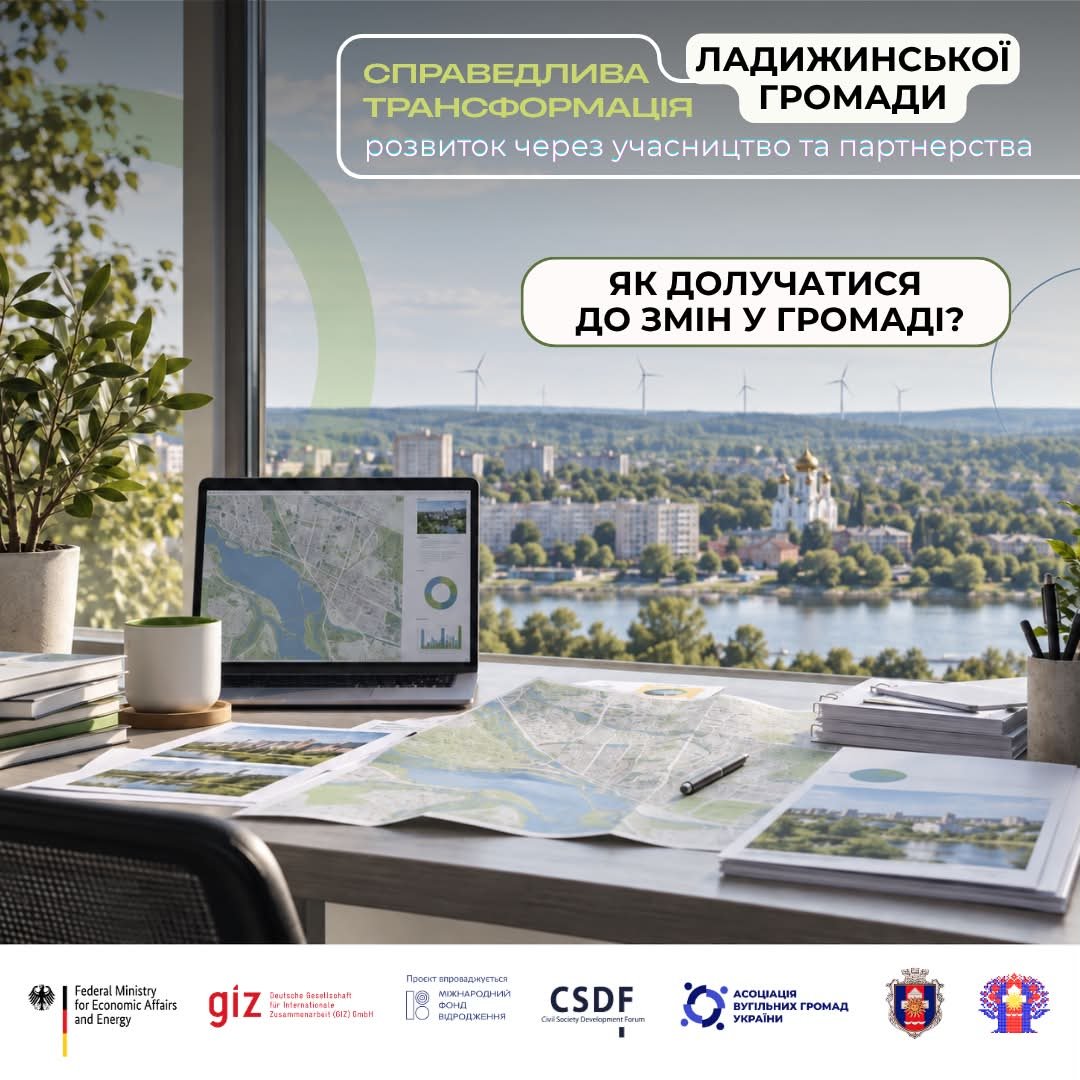
Additional opportunities for participation also arise within the Power4Just Transition project. In the Ladyzhyn community, the component “Just Transition of the Ladyzhyn Community: Development through Participation and Partnership” is being implemented, the aim of which is to involve residents, civil society organisations and initiative groups in developing shared solutions for the community’s development. At present, among other things, work is under way on updating the Community Charter, which is meant to establish clear mechanisms of civic participation.
To influence decisions you do not have to be a council member, work in the City Council or have many years of experience in civic activity. You can start with what truly troubles or, on the contrary, inspires you: talk to others, formulate your proposal and find a way to bring it to where decisions are being prepared.
That is why recruitment will start soon for representatives of non-governmental organisations, initiative groups and active residents of Ladyzhyn to join the innovative “Academy of Participatory Just Transition”, where everyone (men and women alike) will be able to begin the journey of addressing pressing issues of community development using civic participation mechanisms and in partnership.
A community does not have to be a place where everyone thinks alike. It is far more important that different people can talk about what matters to them, hear one another and have a clear path to participation in shared decisions.
For Ladyzhyn, which is preparing for serious changes, this is especially important. After all, just transition becomes truly just not when changes are well planned for people, but when they are planned together with people.