What will Ladyzhyn be like in 10–15 years? Will it remain a city where young people see their future? What jobs will appear here? What will healthcare, education, social services and the local economy be like? What will the environmental situation be? There are no ready-made answers to these questions. They will not be found in a single day. They will not be found in a single office – not in the City Council, not in the capital, not in the office of an international organisation. The future of a community is made up of countless different needs, ideas and opportunities, of the voices of thousands of people who live, work and plan their future right here. Just transition begins not only with plans and documents, but with a conversation about how the community wants to see itself in the future.
There is a fairly simple and tempting path: to entrust the answers to difficult questions and the solving of problems to certain specific people – let them draw up a strategy, calculate the budget and make the decisions. But no single person or structure holds the whole picture of what a community needs. An entrepreneur sees the city differently from an enterprise worker. A young person has different needs and interests from parents with children or pensioners. A representative of a civil society organisation may see more clearly the problems of a particular vulnerable group, while the local authorities know which decisions the community can realistically adopt and fund. Each of these views is only part of the truth about Ladyzhyn.
Plans written without the participation of residents often share the same fate: they either fail to match real needs or run into resistance from those they were supposed to affect. The logic is simple – a decision taken without dialogue is harder to implement, because people do not feel it is theirs. They do not defend it when things get difficult and do not support it when joint efforts are needed.
A striking historical example was the closure of coal mines in Great Britain in the 1980s. At that time the government took an abrupt decision to wind down the industry without ensuring sufficient participation of local communities in determining the future of the territories and without preparing proper alternatives for people and the local economy. The consequences were large-scale strikes, mass unemployment and a prolonged economic depression in mining towns.
By contrast, the later European experience of transforming coal regions showed a different approach: involving residents and other stakeholders already at the stage of planning change, rather than after the main decisions have been taken. In such an approach, funding is only one element. Dialogue, jointly setting priorities, searching for solutions and involving local people in implementing them become no less important.
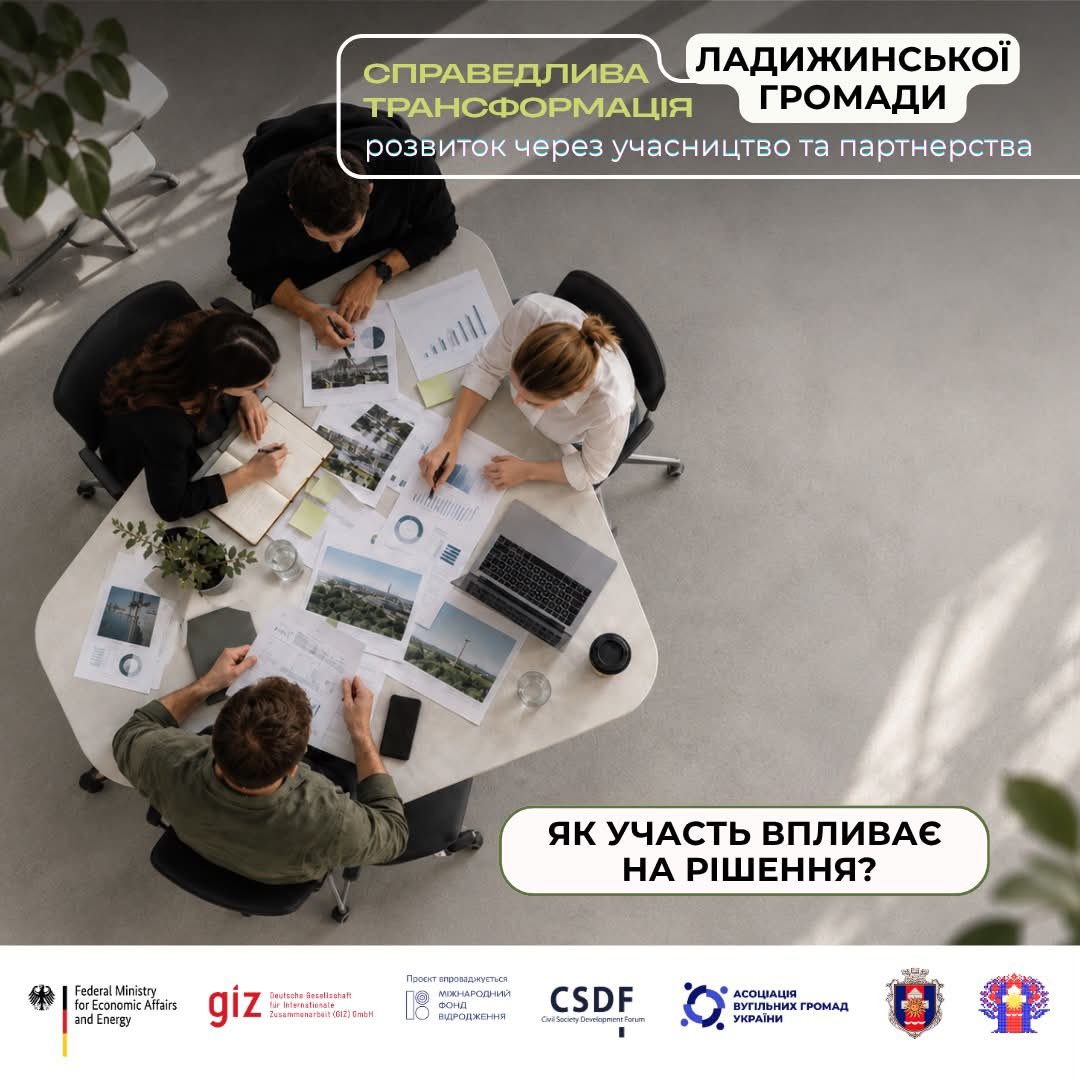
One community – many voices
The word “community” is often understood as if it meant one large group of people with the same interests and needs. In reality, a community is more like a picture assembled from many puzzle pieces.
One piece is young people. They need quality education, work, housing, opportunities for development, an interesting environment of peers, and entertainment. If these opportunities are not there, they will look for them in other cities.
Another piece is the people who work. What matters to them is stable jobs, decent pay, the chance to retrain and find new work if the community’s economy changes.
Next to them are entrepreneurs. They are interested in investment, infrastructure, and access to resources, markets and skilled workers. It is the development of local business that can create new jobs and increase economic activity.
There is the older generation. For them, accessible healthcare, social services, heating, a safe environment and financial stability are especially important. There are also internally displaced persons, veterans and vulnerable groups of citizens, who have their own needs and priorities.
At the same time, the interests of all these groups do not contradict one another. On the contrary, they are in many ways interconnected. If a community has no opportunities for young people, they leave. Fewer people means fewer workers and consumers, and the local economy weakens. It becomes harder for business to develop and for the community to receive the revenues it needs. This, in turn, limits the funding available for social services and for supporting the people who need them.
Likewise, you cannot develop business without thinking about workers. You cannot plan new jobs without understanding which professions will be needed. You cannot speak of a comfortable community if some people have no access to basic services.
That is why it is important to see not separate interests but the whole picture of the community’s future, assembled from different puzzle pieces.
Who else shapes the community’s future
But a community is not only separate groups of residents. It also includes those who have different capacities and tools for influencing change.
Local self-government has the powers and the responsibility to turn a shared vision into concrete decisions. It is at the community level that decisions are taken on the local budget, infrastructure, utility services, spatial development, education, social support and many other matters. The role of the local authorities, therefore, is not simply to take decisions, but to create conditions in which different voices are heard, to reconcile interests and to ensure that agreements are implemented.
Non-governmental and civil society organisations perform a different but no less important function. They often work directly with people and know well the problems of particular groups. They can help to involve those who rarely take part in public discussions, organise dialogue, conduct research, provide expertise, teach people new tools of participation or help the community find resources for a specific initiative.
Business is not only a party that expects favourable conditions for operating. In the process of just transition it can be one of the drivers of change: investing in new production facilities, the modernisation of enterprises, energy efficiency, the development of new sectors of the economy and the training of workers. At the same time, it is important for business to understand what the community wants to be in the future and which workforce, infrastructure and conditions will be needed for this.
Experts, educational institutions and academics help to see what is hard to assess from everyday experience alone. They can analyse economic, social and environmental trends, assess risks, propose different development scenarios and help to test how far the proposed solutions can really work.
International partners contribute greatly to the process of positive change, combining financial support with expertise, the experience of European communities, training, access to new tools and the opportunity to exchange practices with communities that have already gone through similar transformations. Such support allows communities not only to implement specific projects but also to strengthen their own capacity to plan change, involve different groups and find long-term solutions for development.
But it is important to understand that the role of international partners is not to determine the community’s future in place of its residents, but to help the community realise its own vision by providing additional knowledge, experience, resources and opportunities.
From participation to joint action
Participation in just transition is not only an opportunity to express an opinion. Real participation begins when people’s voices influence decisions. When residents’ proposals are taken into account in setting priorities. When business understands what changes are coming and can offer its own solutions. When civil society organisations help to convey the positions of those who are hard to hear. When experts help to test the viability of ideas. And when the local authorities take responsibility for ensuring that agreed decisions do not remain mere words.
In other words, just transition is not a one-off meeting or a public discussion held for the sake of form. It is a continuous cycle: listen – discuss – agree – plan – implement – check the result and, if necessary, change the approach.
Just transition is not a document that can one day be put on a shelf. It is a continuous process of searching for answers to the questions: how do we want to see our community in the future, and what is each of us ready to do for it?
For Ladyzhyn this question is not purely theoretical. The development of the community’s Just Transition Plan began last September. More than 200 representatives of civil society, business, local authorities and the expert community joined the process. In June, the Working Group agreed the goals and objectives of the Plan, and the next step was the formation of concrete project ideas. Work continues on the Charter of the territorial community, and public hearings will begin soon. Once the Charter is adopted, the “Academy of Participatory Just Transition” will start, during which every active resident (man and woman) will master the mechanisms of civic participation and of influencing decision-making for the development of the Ladyzhyn community.
In 10–15 years, Ladyzhyn will be what the decisions taken today make of it. The future of the community is a shared responsibility. It will be made up of many decisions, voices and actions. And the more people, organisations and institutions do not merely watch these changes but take part in creating them, the greater the chance that Ladyzhyn will become a community where one wants not only to live today but also to build one’s future tomorrow.