Around the world, approaches to energy have been changing for more than a decade. Coal mines and thermal power plants are gradually losing their role, giving way to green energy sources, new technologies and new sectors of the economy.
Just transition is meant to make these changes manageable: not simply to close old production facilities, but to prepare in advance a reliable economic base for the community – to provide new sources of income, create jobs and turn challenges into real opportunities.
Ukrainian single-industry communities, Ladyzhyn among them, are going through their just transition under extremely difficult conditions of war, the destruction of enterprises and energy infrastructure, and the migration of people. On the one hand, this complicates the transformation. On the other, it makes it all the more relevant. There is no point in rebuilding the economy on the old model when that model itself has become vulnerable. Recovery offers a chance to create new production facilities, new jobs and a more resilient energy system right away.
Let us try to understand how just transition is taking place in Ukraine today, what in this process depends on the state and international partners, and what active role the residents of the community can play themselves.
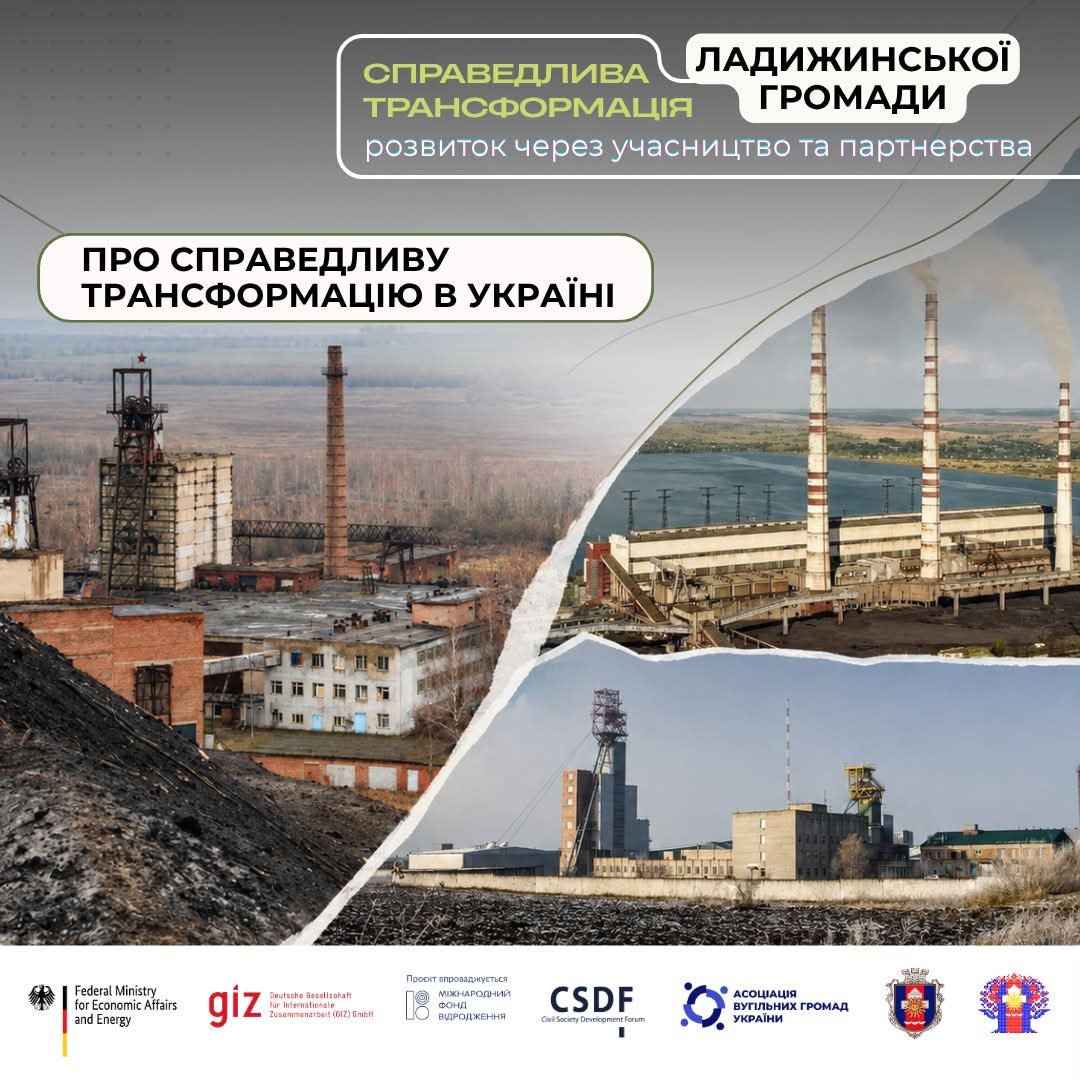
Who is responsible for just transition
Just transition is not the responsibility or task of any one party. It is a synergy of the efforts of the state, international partners, the community and its residents, where each side is responsible for its own part of the process and at the same time works towards a shared result.
The state
It sets the rules and creates the general conditions. It is the government that defines state policy, adopts programmes, allocates state resources, and shapes mechanisms of support, investment and territorial development.
Ukraine began systematically shaping its just transition policy even before the full-scale war. In 2021, the government set out the main directions of future change by approving the concept of a state programme for coal regions up to 2030. And in June 2025 it approved the programme itself, which provides for the diversification of the local economy, the development of human potential, better living conditions, energy efficiency and the solution of environmental problems. Its implementation involves joint work by the state, local self-government, residents, civil society organisations and international partners.
International partners
They provide what is often lacking at the local level: financial resources, expertise, technologies and the experience of other countries.
For EU countries, supporting the just transition of Ukraine’s coal communities is not merely aid but a contribution to shared security and shared long-term interests. Several aims come together here: strengthening Ukraine’s energy and economic resilience, reducing environmental risks, moving closer to European standards and creating conditions for further trade, investment and economic cooperation. Strong Ukrainian communities and a more modern energy sector mean fewer risks for the entire region, while the development of new enterprises and infrastructure opens up opportunities for partnership. That is why supporting the transformation is at once help for Ukraine and an investment in a more stable, safer and more economically beneficial future for all sides.
Funding can take different forms – from grants and technical assistance to international programmes supporting projects in energy efficiency, retraining, local economic development, ecology and infrastructure modernisation.
One of Ukraine’s most prominent partners in the just transition process is the Deutsche Gesellschaft für Internationale Zusammenarbeit (GIZ) GmbH. In June 2021, on behalf of the German government, GIZ launched the project “Support for Structural Change in Ukraine’s Coal Regions”. It provided for support of dialogue between the state, communities and other participants in the transformation, the development of strategies that take account of the needs of specific territories, the use of the experience of other European coal regions, and advisory support to the government on policy and on mechanisms for financing the transformation.
This work is continued by the Power4Just Transition programme, a three-year project that GIZ is implementing on behalf of the German government in partnership with Ukrainian authorities. The programme is aimed at supporting the economic development and the transformation of the energy systems of Ukraine’s coal regions. The Ladyzhyn community is part of this project. In June 2026, a separate component, “Just Transition of the Ladyzhyn Community: Development through Participation and Partnership”, was launched in the community under Power4Just Transition. Its aim is to involve residents, civil society organisations and initiative groups in shaping the community’s future and developing shared solutions for its development.
The community
Local self-government, together with the residents of the community, is responsible for determining the specific needs of the territory and its development priorities. Funding, expertise or ready-made tools can be provided from outside, but it is local people who know the particular features of their community best and can determine which solutions will really work.
An important role in enabling communities to act together and defend their interests more actively is played by the Association of Coal Communities of Ukraine. It was established in November 2023 on the initiative of local self-government bodies. Today the Association unites 25 communities and serves as a platform for exchanging experience, jointly representing interests before the state, and seeking opportunities for development and funding. It also helps communities with preparing grant applications, strategic planning and implementing just transition measures.
In September 2025, the Ladyzhyn community began developing its own Just Transition Plan. More than 200 representatives of civil society, business, local authorities and the expert community have already joined the work. In June 2026, the Working Group agreed the goals and objectives of the Plan, after which the community began to collect specific project ideas.
Just transition is not a one-off event but a long process in which each side does its part: the state sets the framework, international partners provide resources and experience, the Association of Coal Communities of Ukraine unites the efforts of communities, and the community itself, together with its residents, decides how to turn these opportunities into concrete projects. For Ladyzhyn, whose economy rested on thermal generation for decades, this is not about renouncing the past but about building a new foundation: a diversified economy, new jobs and an energy system more resilient to the challenges the war has brought. The Plan that the community is now preparing is meant to become the tool that turns the general principles of just transition into concrete steps for Ladyzhyn.