What do Ukraine’s Ladyzhyn, Germany’s Essen, Poland’s Katowice and the Slovak town of Nováky have in common? Not much, it would seem. Different countries, different histories, different scales. Yet for many years all of these communities lived off one large enterprise or even an entire industry. For some it was coal mines, for others metallurgy or power plants. These provided jobs, filled budgets and shaped the lives of whole generations.
But a moment came when this dependence stopped being a pillar of support and became a risk. Mines closed, power plants aged, technologies changed, and with them the economic and environmental rules of the game. The communities faced the same question: how to ensure that change does not become a blow to people, but opens up new opportunities for development?
In Europe, the answer to such challenges has been just transition, which helps to make economic change as painless as possible, to protect residents and to create conditions in which a city relies not on a single large enterprise but on a diverse and resilient economy.
That is why the collective experience of cities and regions that have already travelled this road is so important today for Ladyzhyn, which is only beginning its own transformation.
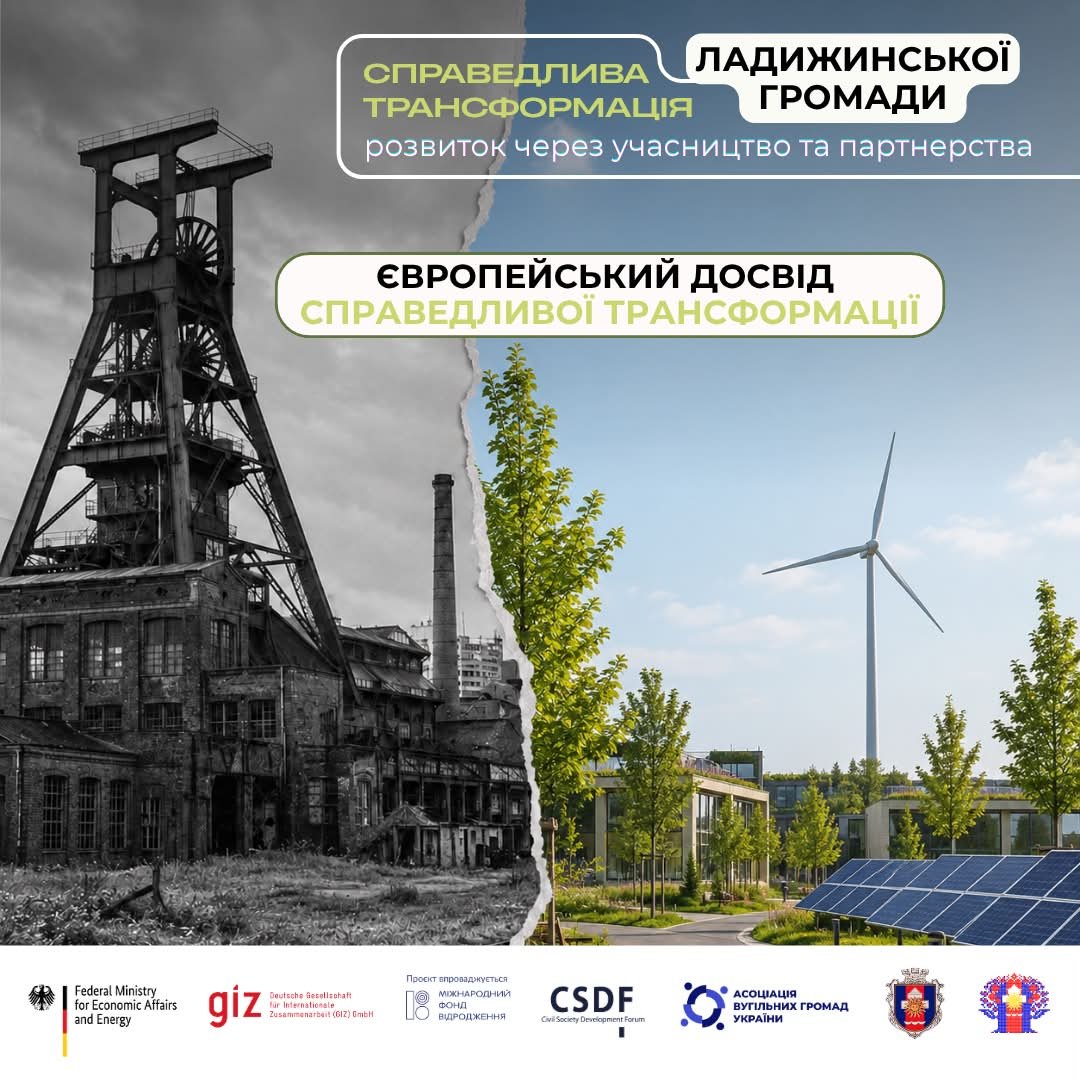
Real stories that inspire
In European countries, single-industry communities have been transforming for more than a decade. There is no universal recipe – each community has found its own path. But the experience of different countries shows that if change is planned in advance and together with people, it can become a spur to new development. There are dozens, even hundreds, of successful examples of just transition around the world. To make the point clearer, we will give at least a few of the most telling stories from Europe, which is close to us.
Half a century ago, the city of Essen was one of the symbols of heavy industry in Germany. Mines, metallurgical enterprises and factories operated around the city, and most families were connected with this industry in one way or another. When demand for coal began to fall, change did not happen overnight. The closure of the mines took decades, while the city gradually looked for new sources of development.
Today Essen is a large business, scientific and cultural centre. Universities and the offices of international companies operate here, and modern technologies and the service sector are developing. At the same time, the city has not abandoned its industrial heritage. For example, the former Zollverein industrial complex, where coal was once mined and coke produced, is now on the UNESCO World Heritage List. In place of factory halls there are museums, exhibition spaces and cultural venues that hundreds of thousands of people visit every year.
A few decades ago, Katowice in Poland was associated first and foremost with coal. Today the city remains an important industrial centre, but its economy has become much more diverse. IT, business services, modern offices, education and culture are actively developing here. On the site of a former mine, the modern Silesian Museum has opened, and the area around it has turned into a new cultural quarter of the city. Katowice regularly hosts major international conferences, exhibitions and cultural events.
The experience closest and most instructive for Ladyzhyn is that of the small Slovak town of Nováky. For decades, the life of this settlement of a few thousand people was tied to a coal-fired power plant and the mines of the Upper Nitra region. When Slovakia decided to give up coal, they did not stop at closing down the old industry. With the support of the European Union, they began to attract new investment, create modern production facilities, help workers (men and women) acquire new professions and prepare the economy for the future. Since the power plant ceased operating, major investors have come to the region and are now building a factory for electric-vehicle components. This is an example of how even a small community can go through difficult changes if it plans them in advance and relies on the support of the state and international partners.
Practices that work
Global experience shows a simple thing: a successful transformation never rests on one large project – it is made up of dozens of smaller decisions that reinforce one another. Communities support small and medium-sized businesses and help entrepreneurs (men and women) to start their own ventures and create new jobs. Old industrial sites are not left abandoned – industrial parks, museums, offices or innovation hubs appear in their place. And instead of waiting for an investor to knock on the door, communities prepare quality projects and offer them to international funds, state programmes and private business.
But money and buildings are only half the story. Equally important is who makes decisions and how. It works best when representatives of the authorities, business, enterprise workers, experts and residents of the community sit at one table – then decisions become more realistic. Education and retraining give people a chance to find their place in the new economy rather than be left on the sidelines of change. And perhaps most important of all, residents do not merely watch the transformation, but propose ideas themselves and determine what the community really needs.
What successful communities have in common
Despite different countries, different scales and different histories, the most successful examples have a great deal in common.
First, they began planning change before the situation became critical. Second, decisions were not made behind closed doors – the community was involved. Third, large sums were invested not only in buildings or roads, but above all in people: education, retraining and the creation of new opportunities. Fourth, communities actively sought partners and investors, using state and international support programmes. And finally, they understood that a real transformation does not happen in one or two years. It is a development strategy for decades ahead.
Take the best and follow your own path
Ladyzhyn will not become a copy of Essen, Katowice or any other city. Nor should it. Every community has its own history, its own resources, its own challenges and its own opportunities. This is especially true today, when Ukraine is simultaneously going through war, economic hardship, recovery and preparation for future EU membership.
But the global experience of just transition has produced a huge number of tools and recipes for success that we can draw on. And, above all, this experience proves that communities whose life depended on a single industry for decades can develop successfully. This requires a clear vision of the future, long-term planning, cooperation among all participants and a readiness to seize new opportunities.
For the Ladyzhyn community, it is important to work on its own vision of just transition already today. Not because Europe is doing so, but because this is a chance to build a stronger and more resilient economy with more opportunities for business, young people and investors, and for every resident of the community.
Let us recall that a Working Group is currently at work in the Ladyzhyn community on updating the Charter of the territorial community – a document that introduces civic participation mechanisms and creates the proper conditions for the just transition of Ladyzhyn with the involvement of all stakeholders.