A successful community is built not only on the decisions of the local authorities. It is the result of daily teamwork in which every voice matters. We explain how non-governmental organisations and initiative groups help turn ideas into real projects, and why the participation of caring people is the main driver of positive change in Ladyzhyn.
For many people, the word “community” is associated first of all with something abstract – the city council, the budget, utility services. But in reality, the community is first of all you and me. Streets, parks, schools, cultural life – all of this gets better not by itself but because someone nearby takes it up and does it. A town or village begins to develop in earnest only when residents stop being spectators and become those who create the space around them.
For the Ladyzhyn community, this is exactly the moment when this matters most. The community is going through a difficult but important period of change – where to go next, for years ahead, is being rethought. Right now, decisions are being laid down that will determine whether new jobs appear, what the standard of education will be, how infrastructure will develop and whether young people will stay here rather than leave for places that “have prospects”. The voice and participation of ordinary people in this process are not a formality but a real lever of influence.
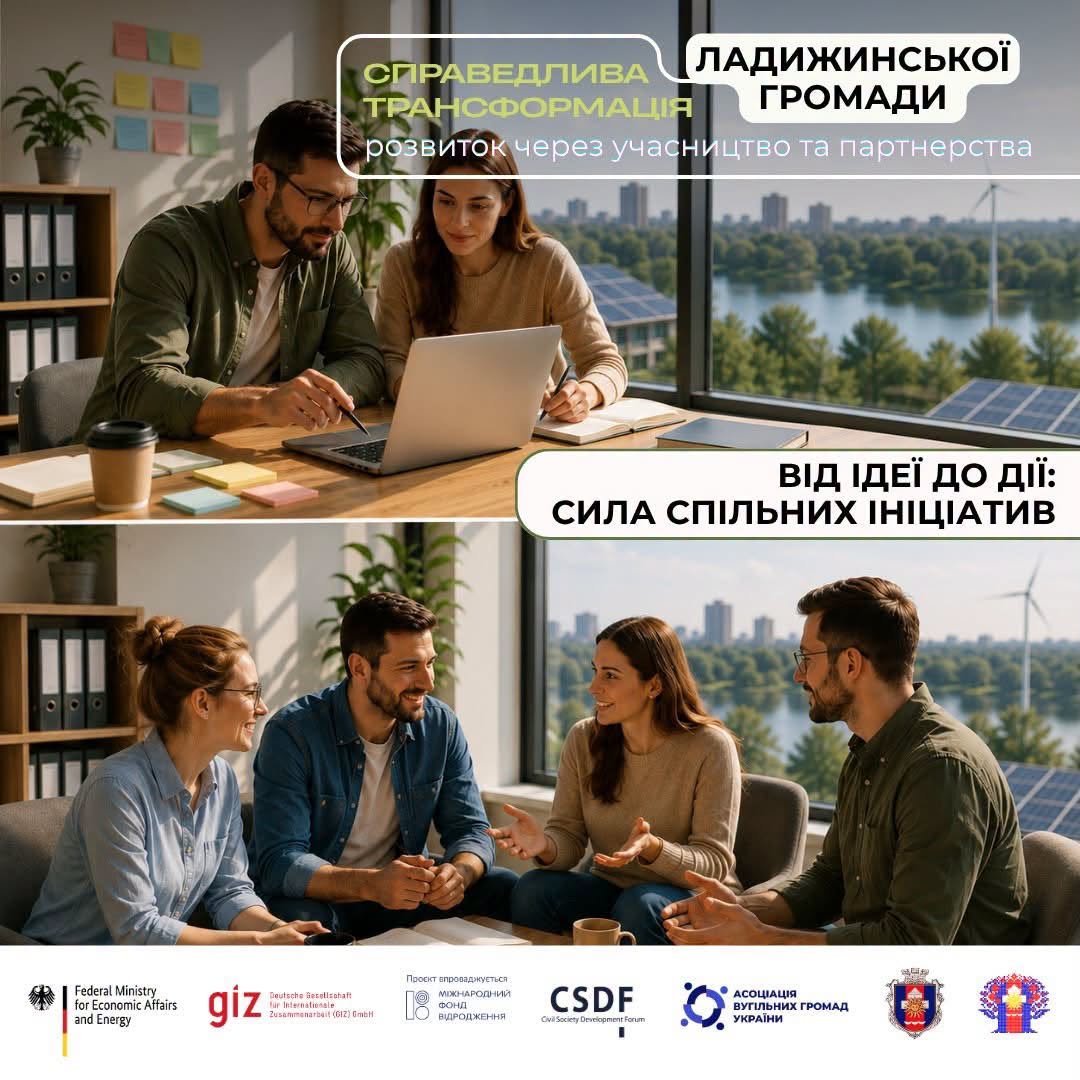
Non-governmental organisations – a bridge between ideas and opportunities
Non-governmental organisations are teams of people who work not for profit but to solve specific problems or to give a push to the realisation of ideas. One of the greatest strengths of such organisations is the ability to attract additional funds. Grants from international partners, charitable foundations or state programmes make it possible to carry out projects for which the local budget often simply falls short. This is how new spaces, educational programmes, modern equipment or social services can appear in a community.
Importantly, non-governmental organisations accumulate knowledge, contacts and practical experience. They see how similar challenges are overcome in other towns in Ukraine and Europe, adopt successful practices, help adapt them to local needs and give a push to the development and implementation of promising ideas.
For example, after the latest dialogue workshop, organised by the Civil Society Development Forum NGO in partnership with the Association of Coal Communities of Ukraine, American non-governmental organisations and active residents of Ladyzhyn, participants developed and discussed 16 ideas for just transition projects. These ideas will be submitted for consideration as part of the preparation of the Just Transition Plan.
The best results are achieved when non-governmental organisations and the local authorities work as partners. Some know people’s needs well and are able to attract resources and organise projects, while others create the conditions for their implementation. Such cooperation helps put useful changes into practice faster. Often the civil society sector takes on part of the tasks that the administration itself finds hard to cover physically or professionally, and this frees up resources for other pressing matters.
Initiative groups – the strength of caring people
Not every good cause starts with an official organisation, stamps and a pile of documents. Often a few active people who have decided not to wait for someone else to solve the problem are enough. This is how initiative groups are born.
Their main advantage is speed and flexibility. If an idea appears today to plant trees, organise a community work day, set up a children’s corner or create a club of shared interests, within a few days it can become reality. Without complicated procedures and unnecessary bureaucracy.
Such initiatives often start small but have a significant effect. A renovated courtyard motivates neighbours to look after it, a shared clean-up brings people together, and a small local project can become an example for other streets or buildings in the community. This is how the culture of mutual responsibility gradually changes.
When people of different ages, professions and experience come together, stronger solutions are born. Someone knows how to organise a community, someone knows construction, and someone works well with documents and is well versed in legislation. This is how real synergy arises, where everyone reinforces everyone else.
In many European countries, such activity has long been a normal part of community life. People unite around shared ideas, and the local authorities support their initiatives. It is thanks to such cooperation that towns and villages become more comfortable to live in.
Community development is teamwork. Residents propose ideas, initiative groups help bring them to life quickly, non-governmental organisations find the necessary resources and partners, and the local authorities support such changes and do everything to facilitate them.
Right now, when the Ladyzhyn community is shaping its future within the just transition, such cooperation takes on special significance. After all, the best decisions are born not in offices but in dialogue between people who want to make their community more comfortable, more modern and more successful. And the more caring people join this process, the more reasons there will be to be proud of Ladyzhyn in one, two, ten and fifty years.