Ladyzhyn stands on the threshold of an important stage – just transition. This means that the town is deliberately preparing for change rather than waiting for it to happen on its own. The transformation will be just only if it takes into account the interests of everyone – the power plant worker, the entrepreneur, the young mother and the pensioner alike. And for that, the community must be not an observer but an active participant in the whole process: from shaping ideas and the action plan to putting projects into practice and monitoring how they are carried out.
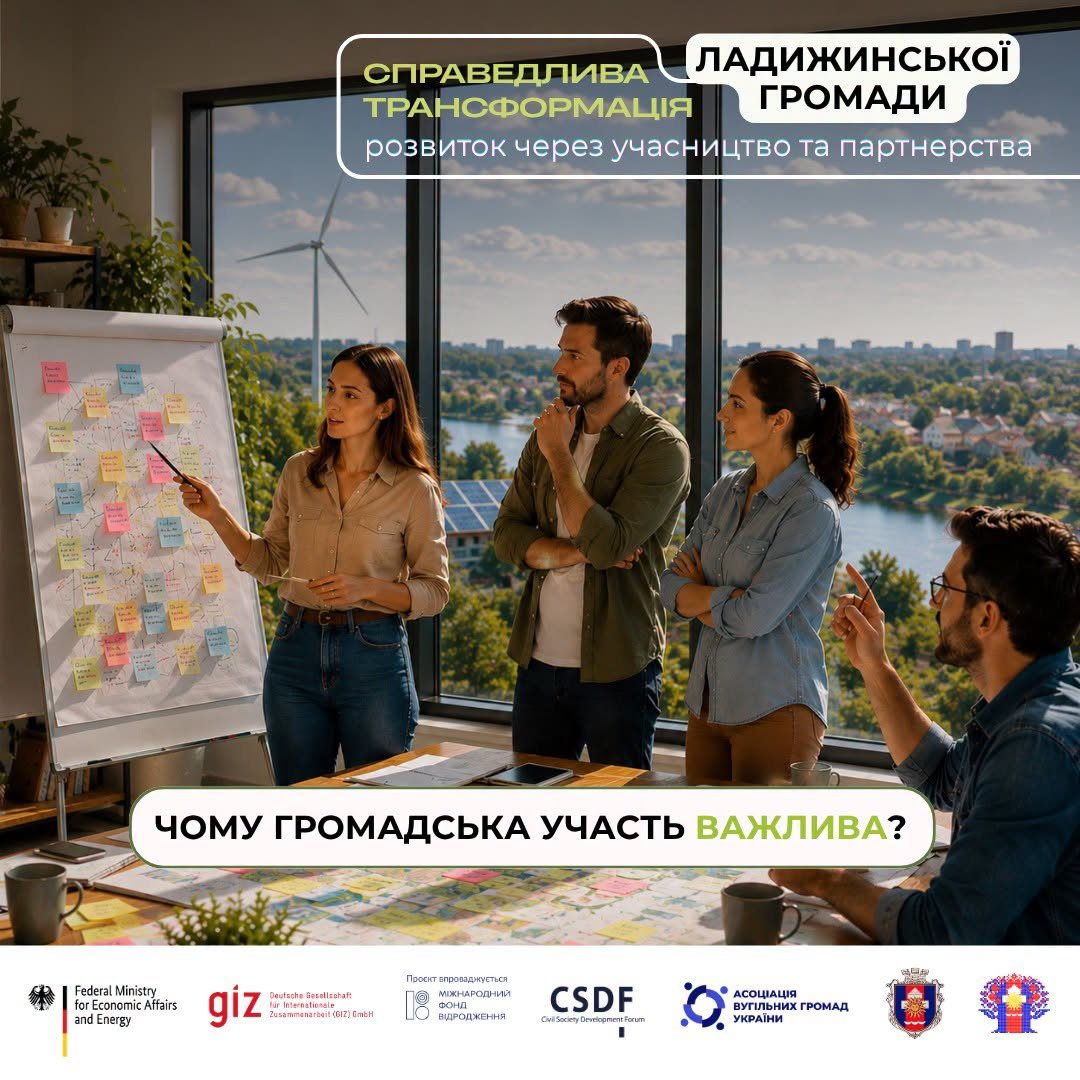
What civic participation is
Civic participation is when residents do not stand aside from what is happening in the community but genuinely influence the authorities’ decisions – on what the town will be like today and what it will become in 5, 10 or 50 years. It is the opportunity to voice proposals, take part in discussions, suggest ideas, support or initiate important projects, and draw attention to problems that need solving.
There are many quite familiar tools for this. For example, public hearings are where residents can jointly take part in shaping decisions by submitting proposals – for instance, on the Charter that is currently being drafted. A petition is when support is gathered for a specific proposal and the authorities are obliged to consider it. A participatory budget is when part of the city’s funds is allocated specifically to projects proposed by residents themselves: to equip a playground, repair a street, install benches in a park. And consultations during the development of strategies are when people’s opinions are taken into account before important decisions are made, rather than presenting them with a fait accompli.
All this is not just theory. Communities in Europe have used these mechanisms for decades to build towns that are comfortable to live in. They understood a simple thing long ago: the best decisions are born when they are discussed together with people.
And most importantly, all the tools of influence and oversight are already available to us as well.
Why residents’ opinions carry such weight
No one knows a town better than those who live in it. A representative of the local authorities, or even the best expert from the capital, can carry out an analysis, read a pile of documents and study figures and charts, but is unlikely to say for certain which services are lacking right now or where the most acute problem with jobs really lies. Residents of the community know this, because they face it every day.
Moreover, the best solution to a problem, or an idea for a new project, is often suggested by local people themselves – after all, they have been thinking it over and discussing it among themselves for years, before the issue ever reached the authorities.
The experience of many communities shows that decisions taken without people’s participation far more often fail to meet expectations or cause dissatisfaction. Conversely, when residents take part in planning, support the proposed changes and feel involved and jointly responsible, projects are implemented much more successfully.
This is why international partners and donor organisations are far more willing to fund projects that are supported by the local population itself. Potential investors think the same way. They look for active communities – those where people are ready to cooperate, propose ideas and take responsibility for putting them into practice. A passive community, even with a good strategy on paper, interests investors far less. After all, a strong community is not only enterprises or infrastructure, but above all active, enterprising and committed residents.
Just transition means that every resident is a co-author of change. These are people who identify problems, shape a vision of the future, join in delivering projects and then keep watch to make sure they are carried out.
Incidentally, many of us are already part of various associations – and these too are an excellent platform for influence. Condominium associations, workforces of enterprises, youth councils, veterans’ organisations, religious communities or even parents’ committees can all put together shared proposals, discuss them jointly and then bring them to the authorities. There is no need to act alone – together it often works better.
Every voice matters
Today Ladyzhyn is completing the preparation of the Just Transition Plan. After several months of work by experts and representatives of the authorities, business and civil society, the collection of project ideas that may be included in this document is under way.
If you have an idea that could help make the community more comfortable, stronger or more successful, now is the time to share it. After review by the Working Group, the best ideas may be included in the Plan and will then be able to apply for funding from state, international and donor programmes.
You can submit your proposal by 15 July 2026 through a dedicated online form at: https://forms.gle/eErpMRb6Pp7smjSF9
Every completed survey, every proposal submitted, every contribution to a discussion or meeting is a real contribution to the town’s development. The more residents join the conversation about the community’s future, the more balanced, effective and fair the decisions become. Join in too!