Ladyzhyn grew up around a thermal power plant that for decades gave residents jobs and supplied electricity to thousands of people across the region. We are rightly proud that our town is a town of power engineers.
But today the world is changing. Since the 1990s, unprofitable mines have gradually been closed in many countries, and coal regions have been looking for new paths of economic development. This trend continues today.
Ukraine, too, faces the need to rethink the future of its coal regions. This is influenced both by the state’s international commitments in climate and energy policy and by economic factors. Supporting obsolete coal enterprises requires significant resources, whereas these investments could be directed towards developing new sectors of the economy and creating modern jobs.
An additional challenge for Ukraine has been the full-scale war, which has destroyed many enterprises and energy infrastructure facilities. The Ladyzhyn thermal power plant has also suffered serious damage, and restoring it is becoming ever more difficult.
That is why the process of “just transition” is neither a random decision nor a temporary initiative, but a response to real economic, social and energy challenges. The aim of this process is to help the community adapt to change and to create new opportunities for its development.
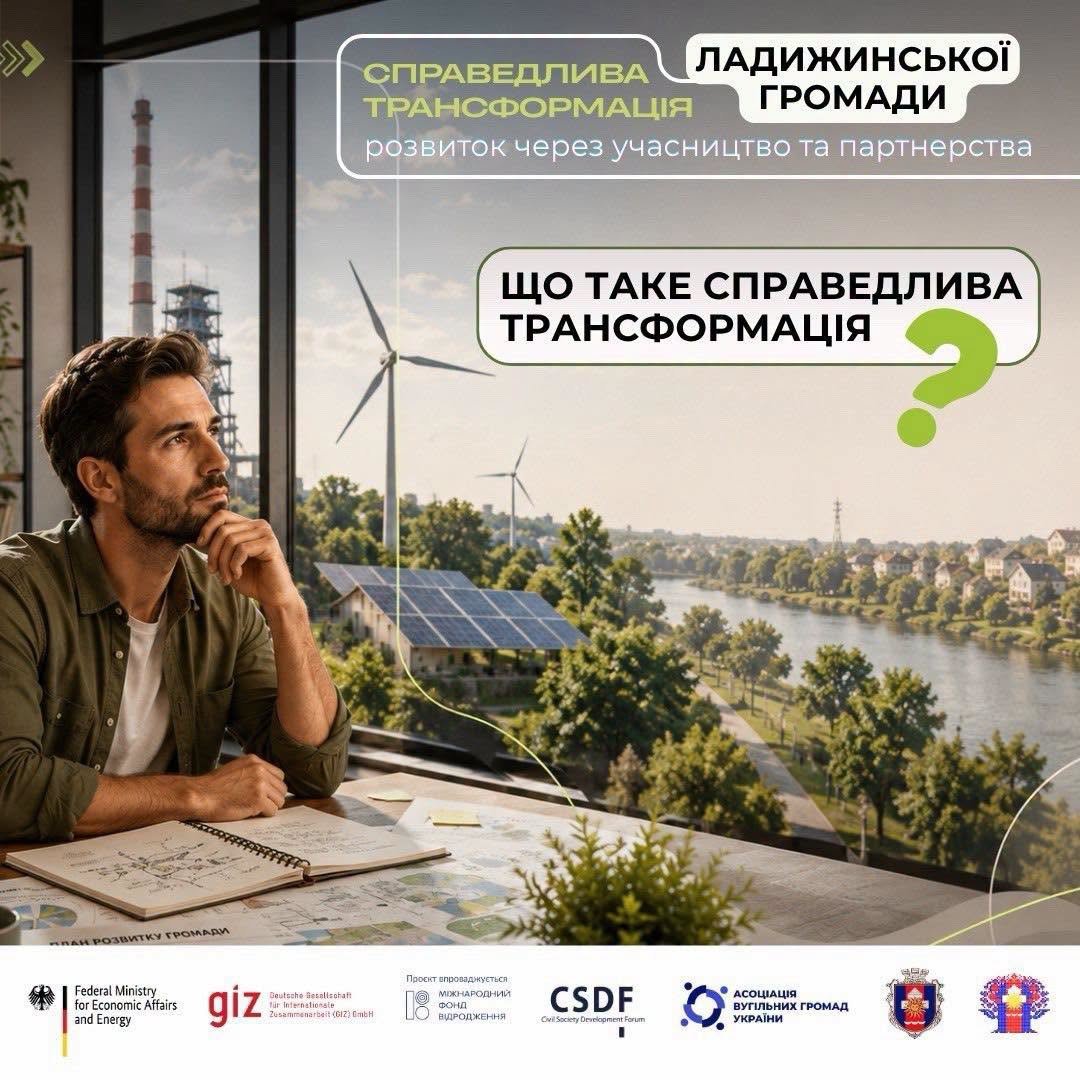
What just transition is
If a particular sector gradually loses its significance or changes, the community should not be left alone with the problems. Instead, people should receive new opportunities for employment, business development and a better quality of life.
Just transition is a model of regional development that involves preserving jobs, retraining workers and creating new economic opportunities. Its main idea is that abandoning obsolete sectors should not lead to a crisis but, on the contrary, should secure a decent future for communities.
In other words, it is about identifying and making use of the community’s strengths, experience, human potential and resources to develop a modern economy. People and their well-being are always at the centre of these changes.
When a community’s economy depends on one large enterprise, any difficulty there is immediately felt by all residents. But when a community is home to a variety of enterprises, business develops, and new investors and projects appear, it becomes stronger and more resilient.
Just transition helps build exactly this kind of development model. International partners, in turn, help the community speed up the implementation of projects by providing modern technologies, advice and resources for high-quality planning and delivery.
For young people, this means more chances to find a good job at home rather than looking for opportunities in other cities or countries. For entrepreneurs, it means new opportunities to start and grow their own business. For the whole community, it means additional budget revenue, more jobs, infrastructure development and a better quality of life.
Europe’s experience: it works
Just transition is not a fashionable new trend or an experiment, but a practice proven over decades, which has helped single-industry towns and regions across Europe and the world to transform.
Most of them live better today than in the days of their “one big enterprise”, because instead of a single point of dependence, many different sources of development have emerged.
For example, Germany’s Ruhr region was once the heart of Europe’s coal industry. Thousands of miners, entire towns that lived “from the mine”. When the pits began to close, many thought the region was doomed.
Instead, the old mining facilities were turned into museums, exhibition centres and tourist attractions. Universities, technology companies and creative businesses appeared. The city of Essen was even named European Capital of Culture. Today the Ruhr is a modern and dynamic region with a diverse economy. There are many similar examples across Europe.
The community itself determines its future
Just transition is not a process that anyone can impose on a community from above. It is not a story in which officials or experts arrive, take decisions in place of the people and present everyone with a fait accompli.
The foundation of just transition is the participation of the community itself. It is residents, business representatives, enterprise employees, young people, civil society organisations and the local authorities who together decide what the future of the town should be, which projects are needed first, and where resources and investment should be directed. Without such a dialogue and without taking everyone’s opinion into account, just transition simply cannot succeed.
The more actively residents take part in discussions, voice their ideas and support good initiatives, the greater the chance that the transformation will bring real benefit to every family living here.
Ladyzhyn is already among the first
Last June, the Cabinet of Ministers approved the State Targeted Programme for the Just Transition of Ukraine’s Coal Regions until 2030. At the same time, the official launch of the “Power4Just Transition” programme took place in Kyiv – a three-year project implemented by GIZ on behalf of the German Federal Ministry for Economic Affairs and Energy, in partnership with the Ministry of Energy, the Ministry for Communities and Territories Development and the Ministry of Environmental Protection of Ukraine.
Across the whole country, the Ladyzhyn community became one of four pilot communities selected to take part in the programme, alongside communities in the Lviv, Volyn and Dnipropetrovsk regions. The fact that Ladyzhyn is among the first is no accident, but recognition of our community’s potential.
The aim of the programme is to strengthen energy security (a stable supply of heat and electricity to the community) and to stimulate the development of the local economy, so that people have heat, light and work. It covers four key areas: support for the local economy, development of decentralised energy, development of human capital, and environmental sustainability.
Change is always a challenge, but also a unique chance. Ladyzhyn has a rich history, hard-working people and enormous potential to become an example of successful renewal. It is time to join forces, share a vision and together build a community where people will want to live, work and raise their children.